
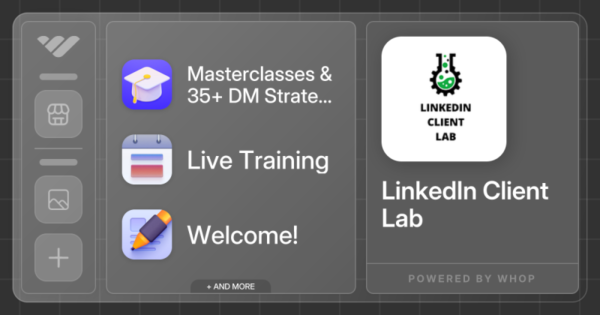

Ty Frankel – LinkedIn Client Lab : Your LinkedIn Profile Is Only the Beginning
A LinkedIn profile can look polished and still fail to bring in business.
You can have a professional headline, a decent About section, regular posts, and hundreds of connections—yet still struggle to turn those activities into meaningful sales conversations. The problem is often not a lack of activity. It is the absence of a connected client acquisition process.
That is the problem Ty Frankel’s LinkedIn Client Lab is designed to address.
The program focuses on using LinkedIn to attract potential clients, establish credibility, develop conversations, and move suitable prospects toward a sales call. Rather than treating profile optimization, content creation, and outreach as unrelated tasks, it brings them together as parts of one business development system.
The current version is marketed as LinkedIn Client Lab 2.0. Its structure places equal attention on the visible parts of client acquisition—such as profiles and direct messages—and the less visible elements, including communication habits, confidence, and emotional control.
For consultants, agency owners, coaches, freelancers, and B2B founders, this makes the program particularly relevant to a familiar challenge: how do you make LinkedIn contribute to revenue instead of simply collecting connections and impressions?
The Four Parts of the Lab
The current Lab 2.0 presentation organizes its training into four main areas. Each addresses a different stage of the process.
1. Profile Training: Make Your Positioning Clear
Your LinkedIn profile is often one of the first places a potential client goes after seeing your content or receiving a message from you.
If the profile is confusing, too broad, or focused entirely on your personal achievements, visitors may not understand what you actually do or why they should speak with you.
The profile training focuses on presenting your business in a way that makes sense to the people you want to reach. The aim is to make your positioning more specific and communicate your value without forcing visitors to piece together the story themselves.
Areas to consider when improving a LinkedIn profile include:
- A headline that communicates your role and market
- An About section written around the problems you help solve
- Clear positioning for a particular type of client
- Relevant proof, experience, and business context
- A profile structure that supports the next step in the sales journey
A useful profile does not need to sound impressive to everyone. It needs to be relevant to the right people.
For example, a general statement such as “I help businesses grow” gives a prospect very little information. A more focused description can explain the type of business served, the problem addressed, and the service provided.
That clarity can make a profile more useful as a landing page for conversations that begin elsewhere on LinkedIn.
2. Content Training: Give People a Reason to Pay Attention
Posting frequently is not the same as building authority.
A business owner can publish every day and still attract the wrong audience, receive little meaningful engagement, or struggle to connect their content with their offer.
The content section is designed to help members think more deliberately about what they publish and how it supports their client acquisition goals. Ty Frankel’s public descriptions emphasize using LinkedIn content to nurture an audience and build familiarity before a sales conversation takes place.
That means content should do more than fill a posting calendar. It should help potential clients understand your perspective, recognize relevant problems, and become familiar with the way you approach your work.
Useful content directions for a B2B service business can include:
- Explaining common problems in your market
- Sharing practical observations from your area of expertise
- Addressing misconceptions that hold buyers back
- Showing how you approach a business challenge
- Discussing lessons learned from client work, where disclosure is appropriate
- Responding to questions your prospects regularly ask
The value of a content strategy is not measured only by likes or impressions. It is also worth asking whether the right people are seeing the posts and whether those posts help them understand your expertise.
A smaller audience made up of relevant decision-makers can be more commercially useful than a large audience with little connection to your service.
3. DM Training: Turn Conversations Into Opportunities
Direct messaging is one of the most prominent parts of LinkedIn Client Lab.
For many service providers, this is also the stage where client acquisition becomes uncomfortable. They may know whom they want to reach but struggle with what to say, how to follow up, or how to move a conversation forward without sounding like a scripted salesperson.
The Lab 2.0 description identifies DM training as its largest section. It highlights conversation strategies, including multi-thread conversations, initial messages, restrained compliments, and other ways of communicating with prospects.
The broader objective is to make outreach feel more natural and relevant.
A productive LinkedIn conversation should not begin with a long pitch that assumes the recipient is ready to buy. It should give both people a reason to continue talking.
The training’s subject areas are relevant to questions such as:
- How can you open a conversation without sending a generic sales pitch?
- How do you make a message feel personal without overdoing it?
- When should you ask a question, and what should that question accomplish?
- How can you follow up without repeatedly sending the same message?
- How do you respond when a prospect raises an objection?
- How can you recognize when a conversation is moving toward a sales opportunity?
The program also describes more advanced conversation concepts, including managing multiple discussion threads and adapting messages to different prospect situations.
These skills are especially useful for businesses selling services that require trust and discussion before a purchase. A potential client may need to understand the provider’s expertise, approach, and suitability before agreeing to a call.
The goal should be to create relevant conversations—not to pressure people into meetings they do not want.
4. Inner Work: Improve the Person Behind the Sales Process
A sales system can look excellent on paper and still be difficult to execute consistently.
Some business owners avoid following up because they worry about appearing pushy. Others become overly attached to whether a prospect replies, hesitate to communicate their value, or change their approach after a few unsuccessful conversations.
The Inner Work section is one of the distinctive elements of the current Lab 2.0 positioning. Ty Frankel presents the program as covering the psychological and emotional side of client acquisition alongside the tactical strategies.
This part of the training is concerned with the way a person’s internal state can influence their communication.
Relevant areas include:
- Becoming more comfortable initiating conversations
- Managing the emotional response to rejection or silence
- Communicating with confidence without becoming aggressive
- Avoiding desperate or overly attached sales behavior
- Developing a more consistent approach to prospect interactions
- Maintaining a professional attitude throughout the sales process
This is not a substitute for learning sales fundamentals. Rather, it addresses a different part of the challenge: applying those fundamentals consistently when conversations do not always go as expected.
For someone who understands outreach but struggles to execute it with confidence, this may be an important area to explore.
A Roadmap Instead of Random LinkedIn Activity
One challenge with online training is knowing what to implement first.
A large library of lessons can contain useful information, but it can also leave members jumping between topics without building a coherent process.
Ty Frankel’s Lab 2.0 announcement describes a 90-day roadmap intended to give members a clearer path from implementation to client acquisition. The idea is to organize the work into a sequence rather than asking members to change everything at once.
A sensible way to think about the process is:
First, clarify your offer and positioning. Make sure the people you want to attract can understand what you do and who you help.
Next, improve your profile. Give visitors a clear explanation of your service and relevant experience.
Then, develop a content routine. Publish material that speaks to your market and demonstrates your perspective.
Build a conversation habit. Start relevant discussions and learn how to handle replies, questions, and follow-ups.
Review what is happening. Look at the quality of conversations, the relevance of prospects, and the progress toward qualified sales calls.
This is a practical way to interpret the program’s broader focus. The exact implementation schedule should be checked inside the version being purchased.
Live Support, Feedback, and the Community
The official Lab 2.0 offer advertises more than recorded lessons. It also describes weekly live calls, a custom LinkedIn profile audit, direct access to Ty for feedback, and a community for B2B founders.
These elements can make a difference when someone is trying to apply a strategy to a real business.
A lesson can explain a messaging principle, but a member may still be unsure how to use it in a specific conversation. Feedback can help identify whether a message is unclear, whether the profile communicates the right offer, or whether the next step in a sales discussion makes sense.
The advertised support features include:
- Weekly live calls with Ty Frankel
- Recordings of live sessions
- A custom profile audit
- Direct access and feedback
- A community of other B2B business owners
These are advertised features of the official membership. Buyers should confirm that the specific checkout option includes them, along with the current call schedule and access terms. A standalone recording archive or third-party copy should not be assumed to include live support or community participation.
Who Is LinkedIn Client Lab For?
The program’s subject matter is most relevant to people who sell services or expertise to other businesses.
Consultants and coaches may use the profile and content frameworks to communicate their positioning and develop conversations with potential clients.
Agency owners may find the outreach and DM material relevant when looking for businesses that need marketing, creative, lead generation, or other specialist services.
Freelancers can use the broader concepts to make their expertise easier to understand and create a more deliberate approach to prospecting.
B2B founders may find the combined focus on positioning, content, and direct conversations useful when building a founder-led sales channel.
Service-based business owners who already have an offer but need a more consistent way to attract suitable prospects may also find the program relevant.
It may be less suitable for someone looking for a completely automated lead generation tool, a done-for-you appointment-setting service, or a guaranteed client acquisition shortcut. The described program is training and support, not a promise that prospects will automatically become customers.
What to Know Before Choosing a Version
LinkedIn Client Lab has had more than one version. The creator has publicly described a substantial rebuild from Lab 1.0 to Lab 2.0, with a clearer learning path and additional emphasis on the psychological side of client acquisition.
That distinction matters when comparing course listings.
A third-party archive may contain older masterclasses, DM strategy videos, transcripts, resources, or recordings from previous live sessions. Those files do not automatically represent the current Lab 2.0 membership.
Before purchasing, confirm:
- Whether the offer is Lab 1.0 or Lab 2.0
- Which lessons and resources are included
- Whether the 90-day roadmap is part of the version
- Whether weekly live calls are available
- Whether the profile audit and direct feedback are included
- Whether community access is provided
- The length of access and update arrangements
- The seller’s identity and refund terms
- Whether the seller has written permission to distribute the original training
A third-party download listing is not proof of authorization to redistribute Ty Frankel’s copyrighted material. Written permission from the rights holder is required before reselling or sharing the original course files.
Final Thoughts
LinkedIn Client Lab is built around a straightforward business idea: client acquisition works better when positioning, content, outreach, and sales communication support one another.
Its strongest point is the combination of practical LinkedIn tactics with the human side of selling. A well-written profile can create clarity. Useful content can build familiarity. Thoughtful messages can open conversations. And better communication habits can help a business owner handle those conversations more professionally.
For consultants, coaches, freelancers, agency owners, and B2B founders who want to develop LinkedIn as a client acquisition channel, the program’s subject matter is relevant.
The results, however, depend on the quality of the offer, the market, the conversations, and the work put into implementation. The creator’s claims about client numbers and revenue should be treated as promotional claims rather than typical or guaranteed outcomes.
The practical takeaway: LinkedIn is not just a place to publish updates. Used thoughtfully, it can become part of a wider process for explaining your value, building trust, and starting business conversations.

Reviews
There are no reviews yet.