
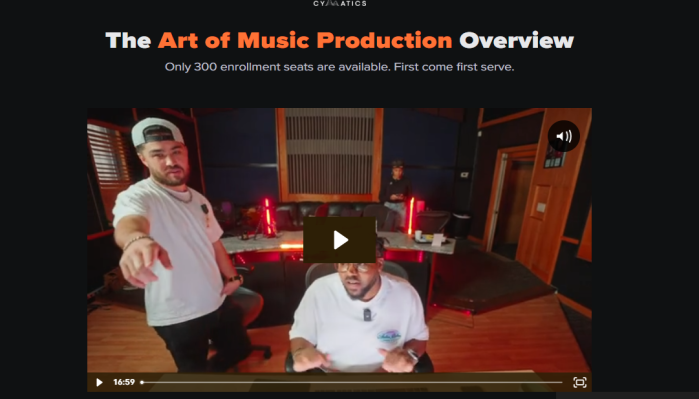

From the First Sample to the Final Master: A Producer’s Journey Through Music Creation
A track rarely comes together in a straight line.
Sometimes it begins with a vocal sample that sparks an idea. Sometimes it starts with a drum pattern, a melody, or a sound that was created by accident while experimenting with a plugin. The challenge is taking that small starting point and turning it into a complete piece of music that feels intentional, balanced, and ready to share.
That is the journey at the center of Cymatics – The Art of Music Production.
Created by Cymatics, this training program brings together ten areas of music production in one structured curriculum. Instead of focusing on just one genre, instrument, or stage of the recording process, it explores the skills involved in building a track from its earliest creative ingredients through to mixing and mastering.
The course covers sampling, song making, vocals, drums, melodies, sound design, mixing, mastering, plugins, and workflow. The official course overview also describes practical exercises alongside the lessons, giving learners opportunities to apply the techniques rather than simply watch demonstrations.
For someone who wants to become more confident in the studio, the value of this broad approach is easy to understand: production is a combination of creative decisions and technical skills. A strong melody needs the right arrangement. A powerful drum pattern needs space in the mix. A good vocal recording needs thoughtful processing. And even a promising track needs a reliable finishing process.
1. The Art of Sampling: Finding Ideas Inside Existing Sounds
Sampling is more than dragging an audio file into a digital audio workstation and placing it on a timeline.
A sample can become a melody, a rhythmic texture, a vocal hook, a new instrument, or the starting point for an entirely different composition. The producer’s job is to hear possibilities that may not be obvious in the original recording.
The sampling section introduces ways to work with source material and turn it into something more personal.
The official course description highlights flipping samples into new ideas and working with stem layers. Its examples also reference production with rap acapellas and singing acapellas, vocal sampling, and learning from the individual elements of a track.
This area is useful for producers who want to become more creative with the sounds they already have.
Topics include:
- Working with sample material and stem layers
- Using vocal recordings as creative ingredients
- Producing with rap and singing acapellas
- Exploring resampling and sound manipulation
- Finding fresh ideas from existing audio
- Developing arrangements from a small musical starting point
One of the practical benefits of learning sampling is that it can help break creative blocks. Instead of waiting for a complete idea to appear, a producer can experiment with an existing sound and build something new around it.
The key is to understand the source material, make deliberate changes, and create a result that feels like its own piece of music.
2. The Art of Song Making: Give Your Ideas a Structure
A loop can sound exciting for eight bars and still be difficult to turn into a full track.
This is a common challenge for producers. They may have a strong melody or drum pattern but struggle to develop it into something with movement, contrast, and a clear beginning, middle, and ending.
The song-making section focuses on the process of building complete musical ideas. Cymatics describes bringing melodies, drums, vocals, mixing, and mastering together to create a finished record.
The official course page references practical production examples across several styles, including trap, drill, R&B, reggaeton, drum and bass, EDM, and lo-fi.
That range matters because different styles require different creative decisions. A drill beat does not necessarily need the same rhythmic feel as a relaxed lo-fi track. An EDM arrangement may rely on tension and release in ways that differ from an R&B production.
The broader subject areas include:
- Developing an idea into a complete arrangement
- Building beats around vocal performances
- Combining melodic and rhythmic elements
- Exploring genre-specific production approaches
- Creating transitions and changes throughout a track
- Making creative decisions that support the overall song
Rather than treating a beat as a collection of separate sounds, this part of the curriculum encourages producers to think about how each element contributes to the full composition.
3. The Art of Vocals: Make the Performance Sit in the Track
Vocals often carry the emotional center of a song. Even a well-produced instrumental can feel incomplete when the vocal is poorly recorded, difficult to understand, or disconnected from the rest of the arrangement.
The vocal section covers recording and processing, with the official description highlighting tuning, layering, and effects.
These techniques serve different purposes.
Tuning can help correct pitch issues where appropriate. Layering can add thickness or create a particular vocal character. Effects such as reverb and delay can help place a vocal within the musical space. Equalization and dynamics processing can help improve clarity and consistency.
The course’s vocal topics include:
- Recording and preparing vocal material
- Working with rap and singing acapellas
- Vocal sampling
- Tuning and layering
- Using effects to shape vocal character
- Mixing vocals so they sit more naturally in a track
The objective is not to apply the same processing chain to every recording. Different voices, microphones, rooms, and musical styles require different decisions.
A useful vocal mix should support the performance rather than bury it under effects.
4. The Art of Drums: Build Rhythm, Energy, and Impact
Drums can define the personality of a production.
A kick and snare establish the foundation, but the character of a beat often comes from the details: hi-hat movement, percussion choices, swing, layering, transitions, and the relationship between the low end and the rest of the arrangement.
Cymatics’ drums section is focused on building and processing patterns that work with the melody and carry the energy of a track.
The official course description highlights layering, swing, and rhythm. The wider curriculum also includes production topics involving 808s, kicks, and drum-focused techniques.
Areas covered include:
- Creating and arranging drum patterns
- Understanding rhythm and groove
- Layering drum sounds
- Working with kicks and 808s
- Adding movement through timing and swing
- Shaping the energy of a beat
- Making the drums work with the melodic elements
A useful drum pattern does not have to be complicated. Sometimes a small change in timing or sound selection can make a beat feel more alive.
The important skill is learning to make choices that serve the track instead of adding layers simply because more sounds are available.
5. The Art of Melodies: Build the Musical Identity
Melodies are often the part of a production that listeners remember.
A strong melodic idea can give a track its mood, emotional direction, and identity. It may come from a simple piano phrase, a synth line, a chord progression, or a sound that has been transformed through creative processing.
The melodies section explores composition, arrangement, and layering. Cymatics describes working with melodies and chord progressions that form the foundation of a song.
The official course overview also includes genre-oriented examples such as synth trap, brass trap, dark trap, reggaeton, and lo-fi melodies.
The subject matter includes:
- Developing melodic ideas
- Creating chord progressions
- Working with different instrument sounds
- Layering melodic elements
- Building loops that support a complete arrangement
- Exploring different moods and genre conventions
The goal is to develop a better understanding of how melody and harmony influence the feeling of a track.
A producer does not need to fill every available space with notes. A simple musical phrase, arranged thoughtfully, can be more effective than a complicated sequence that competes with everything else.
6. The Art of Sound Design: Create More Than Preset-Based Music
Presets are useful. They can save time, provide inspiration, and help producers discover sounds they might not have created from scratch.
But relying entirely on presets can make it harder to develop a distinctive sonic identity.
The sound-design section introduces the process of shaping and creating sounds. Cymatics describes designing original synths, textures, and tones that can help a producer establish a recognizable style.
The official overview also references working with real-world sounds, synthesizing bass sounds, creative sampling, and creating kicks and snares from scratch.
This section is relevant to producers who want to understand why a sound behaves the way it does and how it can be changed to suit a particular musical idea.
Potential areas of exploration include:
- Understanding the fundamentals of sound design
- Manipulating recorded and real-world sounds
- Creating and shaping bass sounds
- Resampling and transforming audio
- Building custom drum elements
- Developing textures and tonal character
Sound design is an experimental skill. Small adjustments to pitch, filtering, envelopes, distortion, modulation, and effects can produce very different results.
Learning to shape sounds deliberately gives producers more creative control over the final arrangement.
7. The Art of Mixing: Make Every Element Work Together
A track can contain excellent individual sounds and still feel messy when they are played together.
The kick may compete with the bass. The vocal may disappear behind the melody. A synth may sound harsh, while the overall mix lacks space or definition.
Mixing is the process of managing those relationships.
Cymatics’ mixing section covers the techniques used to balance and shape a production. The official course description emphasizes clarity, punch, and depth, while the curriculum overview identifies topics such as mixing balance, corrective EQ, 808 and kick mixing, delay, reverb, vocal mixing, compression, and low-end dynamics.
The training areas include:
- Establishing a balanced mix
- Using EQ to shape and correct sounds
- Managing low-frequency elements
- Working with compression
- Applying delay and reverb
- Improving vocal placement
- Creating space and separation
- Controlling dynamics across the track
Mixing decisions should always be made in context. A sound that seems impressive when soloed may not work well when the full arrangement is playing.
This is why listening to the complete track is so important. The objective is not to make every instrument loud or bright. It is to create a balanced result where the important musical elements can be heard clearly.
8. The Art of Mastering: Prepare the Finished Track
Mixing and mastering are related, but they are not the same task.
Mixing focuses on the relationship between the individual elements of a production. Mastering focuses on the final stereo track and its readiness for distribution or playback.
The mastering section introduces techniques for preparing music while maintaining clarity, impact, and dynamics.
The official curriculum includes topics such as:
- Understanding the mastering process
- Using clipping for impact
- Master compression
- Transient shaping
- Sidechain techniques
- Mid-side equalization
- Mastering an EDM track
The important lesson is that mastering is not simply about making a track louder. A good final result needs to preserve the character of the mix while meeting the technical requirements of its intended use.
Producers should also understand that different tracks may require different mastering decisions. A dense electronic production and a softer acoustic arrangement do not necessarily benefit from the same processing choices.
9. The Art of Plugins: Use Your Tools With a Purpose
A large plugin collection does not automatically make someone a better producer.
It is easy to spend time downloading new effects and instruments while overlooking the tools already available in a DAW. What matters is understanding what a plugin does and when it is useful.
Cymatics includes a dedicated plugins section focused on using production tools with greater purpose.
This subject connects technical knowledge with creative decisions. Producers can explore how effects, instruments, and processing tools influence the sound of a track, rather than relying on random settings or presets.
The official 2026 offer also advertises a separate bundle of Cymatics plugins as a bonus. That advertised bonus should be distinguished from the course’s plugin lessons, and its inclusion should be confirmed with the seller for the exact version being purchased.
10. The Art of Workflow: Finish More Music With a Better Process
Creative work can become frustrating when every session begins without a plan.
A producer might spend an entire evening browsing sounds, changing presets, or adjusting small details without moving the track closer to completion.
The workflow section addresses the organization of the production process. Cymatics describes strategies for working faster, staying inspired, and developing consistency.
This area is about building habits that support the creative side of music production.
Useful workflow principles include:
- Organizing samples and project files
- Creating a repeatable session routine
- Reducing unnecessary decisions
- Saving and revisiting useful production ideas
- Knowing when a track needs more work
- Developing a process for completing projects
- Making time for experimentation without losing direction
The aim is not to rush every track. It is to make the creative process more manageable so that ideas have a better chance of becoming finished music.
A Broad Curriculum for Different Producers
The official Cymatics course description says the program is designed for producers working across different genres and does not require a specific DAW.
That makes the curriculum relevant to a wide range of music creators, including:
Beginning producers who want a structured introduction to the major stages of music creation.
Beatmakers who want to strengthen their sampling, melody, drum programming, and arrangement skills.
Vocal producers interested in recording, tuning, layering, and processing vocals.
Electronic music producers looking to improve sound design, mixing, and mastering.
Intermediate producers who understand the basics but want to identify gaps in their production knowledge.
Independent artists who want a better understanding of how songs are built and finished.
The course’s broad approach may be especially useful for learners who have picked up isolated techniques from tutorials but want to understand how the different stages connect.
How to Get More From the Training
Watching a production lesson is only the first step. The real progress happens when you apply the idea to your own project.
A practical way to work through a broad curriculum like this is to keep one project open throughout the learning process.
Start with a sample or musical idea. Develop it into a loop. Build a drum pattern around it. Add a melody or vocal element. Experiment with sound design, then arrange the material into a complete track.
When you reach the mixing and mastering sections, use that same project to understand how the techniques affect the result.
Keep notes about what you changed and why. Save different versions so you can compare the original and revised arrangements. If the course provides exercises and supporting resources in your version, use them to reinforce the lessons.
This approach makes the learning process more practical than watching every lesson without opening your DAW.
Final Verdict
Cymatics – The Art of Music Production brings ten important production disciplines into one learning path. Its strength is the range of subjects: sampling, songwriting, vocals, drums, melodies, sound design, mixing, mastering, plugins, and workflow.
That breadth makes it relevant to producers who want to understand the full creative process rather than focus on a single technique.
It is not a shortcut to producing hit records, and no course can guarantee commercial success. Developing production skills still requires practice, critical listening, experimentation, and completed projects.
Frequently Asked Questions
1. What is Cymatics – The Art of Music Production?
It is a comprehensive music-production training program covering ten areas of production, from sampling and songwriting to mixing, mastering, and workflow.
2. What will I learn in this course?
The curriculum covers sampling, song making, vocals, drums, melodies, sound design, mixing, mastering, plugins, and workflow.
3. Is this course suitable for beginners?
The broad curriculum can be useful for beginners who want to understand the music-production process. Learners should be prepared to practice the techniques in a DAW.
4. Do I need a specific DAW?
Cymatics states that the production knowledge is designed to be applicable across different DAWs. Check the individual lessons for any software-specific demonstrations.
5. Does the course teach mixing and mastering?
Yes. Mixing and mastering are separate sections of the official curriculum, covering topics such as EQ, compression, reverb, low-end dynamics, clipping, and transient shaping.
6. Does it include sound design lessons?
Yes. The sound-design section covers creating and shaping sounds, including synthesizing bass sounds, working with real-world audio, and creative sampling.
7. Does it cover vocal production?
Yes. The vocal curriculum includes recording, processing, tuning, layering, effects, and techniques for making vocals fit into a mix.

Reviews
There are no reviews yet.