

Alex & Elan Yanovsky – Management OS :
The Restaurant Shouldn’t Depend on the Owner for Everything: Inside Management OS
It’s the middle of a busy service. A team member has called in sick, a customer issue needs attention, a manager is waiting for approval, and someone has a question about a process that should already be clear.
The owner gets involved. Again.
This is a familiar situation in restaurants where the business has grown faster than its management systems. The owner may have built a successful operation, but too many decisions still travel through one person. Managers hesitate, responsibilities overlap, and small problems become interruptions throughout the day.
Management OS by Alex and Elan Yanovsky is built around a different way of running a restaurant: give the management team a defined system, make responsibilities visible, and establish repeatable processes for handling people and operations.
It is not simply a collection of leadership ideas. The advertised program is organized around a seven-step management blueprint, supported by lessons, workbooks, practical tools, and a playbook. The intention is to help restaurant owners put a clearer operating structure in place rather than relying on memory, informal conversations, and constant supervision.
A restaurant needs a management system, not another list of reminders
Most restaurant owners already know that employees need direction, hiring needs attention, and daily operations need to be monitored. The difficult part is making those responsibilities happen consistently.
A manager may be excellent at handling customers but less confident when evaluating staff. Another may understand the kitchen operation but struggle to organize team responsibilities. Without a shared management process, performance can vary from one shift or department to another.
Management OS approaches these challenges as connected parts of one operating structure.
The course begins with understanding the current state of the restaurant and then moves into the systems used to manage daily performance, evaluate employees, organize the team, recruit people, train them, and document how work should be done.
That sequence matters. A restaurant cannot improve its management structure simply by drawing a new organizational chart. The roles need to be supported by clear expectations, practical tools, and processes people can follow.
The framework, viewed from the restaurant floor
The published course description identifies eight lessons. Rather than treating each topic as an isolated management subject, the program presents them in an installation sequence.
First, understand what is actually happening
Before changing the way a restaurant is managed, an owner needs a realistic picture of its current condition.
The program’s opening lesson is described as an overview and starting baseline. It introduces the meaning of management, four operating levels, five rooms of a restaurant, and a method for calculating a baseline operational score.
This starting point is useful because business owners can become accustomed to working around recurring problems. A staffing gap may feel normal. A manager constantly asking for approval may seem unavoidable. Inconsistent reporting may be accepted as part of a busy operation.
A baseline gives the owner a way to examine those issues more deliberately.
The advertised Management Audit supports this process by helping identify the areas where the restaurant needs the most attention. Instead of attempting to change everything at once, an owner can begin with the weakest or most important part of the operation.
Then, create a daily management routine
Restaurants generate information throughout the day: staffing changes, service issues, customer feedback, operational mistakes, and tasks that need follow-up.
If that information stays in people’s heads or scattered messages, it becomes difficult to see patterns and make consistent decisions.
Management OS includes a Daily Management Log as one of its tools. The purpose of a structured log is to make important operational information easier to record and review.
A manager can use a routine reporting process to identify what happened, what requires attention, and who is responsible for the next action.
This does not mean adding paperwork for its own sake. A useful daily management routine should make important information easier to act on, not create another administrative burden.
Give employee performance a clearer framework
People management is one of the most demanding parts of restaurant operations. A manager needs to know who is performing well, where someone needs support, and when a recurring issue requires a decision.
The advertised Employee Scoring Matrix gives the course a practical employee-evaluation component.
A structured evaluation method can help managers move beyond vague impressions. Expectations become easier to discuss when the business has defined criteria and a consistent way to review performance.
Of course, a scoring tool should not replace fair judgment or direct communication. Employee evaluations need to account for role expectations, training, working conditions, and relevant context. The value of a matrix comes from making conversations more consistent, not reducing people to a number.
Make the organizational structure understandable
When a restaurant grows, the informal arrangement that worked with a small team may stop working.
Employees may not know who makes a decision. Managers may have overlapping responsibilities. The owner may become the default point of contact for questions that should be handled elsewhere.
The Management OS resources include an Org Chart and H.O.T. Canvas. These are presented as tools for clarifying the management structure and responsibilities.
A useful organizational chart does more than display job titles. It helps people understand reporting relationships and where responsibility sits. The accompanying framework is intended to support clearer management relationships within the restaurant.
This is particularly relevant when a business adds supervisors, department leads, or additional locations. A structure that is understood by everyone is easier to manage than one that exists only in the owner’s head.
Prepare for staffing changes before they become emergencies
Hiring is often treated as a task that begins only when someone leaves. That reactive approach can put pressure on the restaurant, especially when the role is important to daily service.
The advertised course resources include a Replacement Ladder, a hiring pipeline, and hiring scorecards.
These tools address different parts of workforce planning. The replacement framework is intended to help owners think about staffing continuity, while a hiring pipeline and scorecards can bring more structure to candidate evaluation.
The broader lesson is that hiring should not depend entirely on urgency. A restaurant benefits from knowing what a role requires, how candidates will be assessed, and how the team will respond when a position becomes vacant.
Make training a process rather than an informal handover
A new employee can have a very different experience depending on who trains them and how busy the restaurant happens to be.
One manager may explain a task carefully. Another may expect the employee to learn by watching. The result can be inconsistent performance and repeated mistakes.
Management OS lists a 30-Day M1 Ramp among its tools. It is intended to provide a more structured approach to bringing a person into a role.
A defined training period gives managers a reference point for expectations and progress. It can also help the employee understand what they should learn, practise, and demonstrate during the early stages of employment.
The exact implementation will depend on the restaurant, job role, and existing procedures. A kitchen position and a front-of-house position will not necessarily require the same training milestones.
Document processes so the business can repeat them
A restaurant often relies on routines that experienced employees know by heart. That knowledge is valuable, but it becomes a weakness when nobody else understands how the work is supposed to happen.
The program includes process-mapping resources to help document how operational tasks are carried out.
Process maps can make it easier to identify missing steps, unclear handovers, unnecessary complexity, and areas where employees need better instructions.
For example, a restaurant might document its opening routine, stock-check process, or end-of-day handover. Once a process is visible, managers can review it, train employees against it, and update it when the operation changes.
The point is not to turn every small task into a complicated manual. It is to document the processes where consistency matters.
Finally, help the owner step back from the floor
The final lesson is described as a sprint to step back from day-to-day floor operations.
This is an important distinction. The goal is not for the owner to stop caring about the restaurant or ignore its performance. It is to move from personally handling every routine issue toward overseeing a management team that has the tools and authority to do its job.
That transition requires more than delegating tasks. Managers need clear responsibilities, reporting routines, decision-making boundaries, and a way to identify problems before they grow.
The system is intended to help owners develop that structure. How much time an owner can ultimately step away will depend on the restaurant’s team, processes, financial position, and implementation.
What comes with the program?
The published course listing describes several components designed to work together.
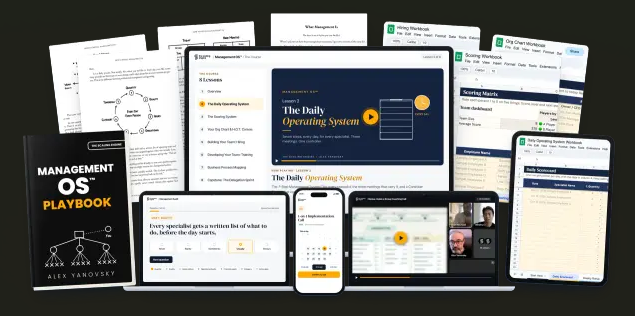
The Management OS Course – 8 Lessons
The video training walks through the management framework in the order it is intended to be installed, covering daily management, employee scoring, organizational structure, hiring, training, process mapping, and the final implementation stage.
The Management OS Playbook – 76 Pages
The playbook is described as a written version of the system, arranged in implementation order. The listing says it includes links to the tools, a worked restaurant example, and a printable one-page checklist.
Seven Workbooks – 16 Management Tools
The workbooks are associated with lessons two through eight. Listed tools include the Daily Management Log, Employee Scoring Matrix, Org Chart, H.O.T. Canvas, Replacement Ladder, hiring pipeline, scorecards, 30-Day M1 Ramp, and process maps. The provider listing says these are supplied through Google Sheets for users to copy.
The Management Audit
A starting assessment intended to help restaurant owners identify which areas of the management system need attention first.
One-on-One Implementation Call
The published offer advertises an individual implementation call to help participants plan the initial setup of the seven-step system. Confirm whether this support is included in the exact offer being purchased.
Recorded Group Coaching Material
The listing also describes a recorded teaching session and two group coaching calls covering employee scoring and organizational structure. These should be treated as advertised resources, not assumed to be ongoing access to live coaching.
Who is likely to benefit?
Management OS is most relevant to people responsible for the operation of a restaurant or hospitality business.
- Independent restaurant owners who are still handling too many routine decisions themselves.
- Growing restaurant operators who need a more consistent way to manage a larger team.
- Restaurant managers who want clearer expectations and practical management routines.
- Hospitality entrepreneurs preparing to build repeatable processes as the business expands.
- Multi-location operators who need more consistent management practices across different teams.
It may be less relevant to someone looking for general corporate leadership training or a broad business-startup course. The material is specifically framed around restaurant management.
A few things to check before buying
There is a difference between the course’s advertised contents and what a particular seller actually provides.
The public product listing describes the eight lessons, playbook, workbooks, audit, and coaching resources. However, third-party download listings are not proof that the seller is authorized to distribute the original training or that all implementation support is included.
Before purchasing, confirm the identity of the seller, whether the materials are supplied by the original provider, the format of access, and whether the one-on-one call and coaching recordings are included. Also check the current price, refund terms, and access period.
The program’s tools can provide structure, but they do not automatically solve staffing shortages, poor service, weak unit economics, or management problems. Their usefulness depends on how well the restaurant adapts and consistently applies them.
The bottom line
Management OS is built for a specific kind of restaurant owner: someone who wants the business to run with clearer management responsibilities instead of depending on the owner’s constant presence.
Its strongest feature is the connection between management concepts and practical resources. The lessons explain the intended system, while the playbook, workbooks, audit, and management tools are designed to help put that system into practice.
For restaurant owners dealing with inconsistent employee accountability, unclear roles, uneven training, or too many decisions coming back to them, the framework is worth examining.
The real test is implementation. A restaurant does not become well-managed because it has an organizational chart or a spreadsheet. It improves when managers use those tools consistently, employees understand what is expected, and operational issues are handled at the right level.
Frequently Asked Questions
1. What is Management OS by Alex and Elan Yanovsky?
Management OS is a restaurant management training program built around a seven-step framework for improving management responsibilities, employee accountability, hiring, training, and operational processes.
2. How many lessons are included?
The advertised course contains eight lessons that guide learners through the management system in its intended implementation order.
3. Is Management OS designed specifically for restaurants?
Yes. Its framework is focused on restaurant operations and the management challenges that arise as restaurant teams and businesses grow.
4. What is the seven-step management system?
It is the central framework used to organize daily management, employee evaluation, organizational structure, hiring, training, and process mapping, with a final implementation stage focused on reducing the owner’s day-to-day involvement.
5. Does the program include workbooks?
The published offer describes seven workbooks containing 16 management tools, including a Daily Management Log, Employee Scoring Matrix, organizational tools, hiring resources, and process maps.
6. What is included in the Management OS Playbook?
The advertised playbook is 76 pages and is described as containing the management framework in installation order, linked tools, a worked restaurant example, and a printable checklist.




Reviews
There are no reviews yet.