

Victoria Gibson – Messaging Source Code: Find a Clearer Way to Communicate What Makes Your Business Different
There is a particular kind of frustration that many experienced business owners know well.
You understand your work. You know the people you want to help. You have experience, skills, client results, and probably a long list of ideas for content and offers. Yet when someone asks what makes your business different, finding a clear answer can feel surprisingly difficult.
You try a new positioning statement. You rewrite your website. You borrow a content framework from someone you follow. For a while, the new approach feels promising, but eventually your marketing starts sounding like everyone else’s again.
The problem may not be a lack of expertise. It may be that the way you communicate your expertise has become disconnected from what makes your business distinctive.
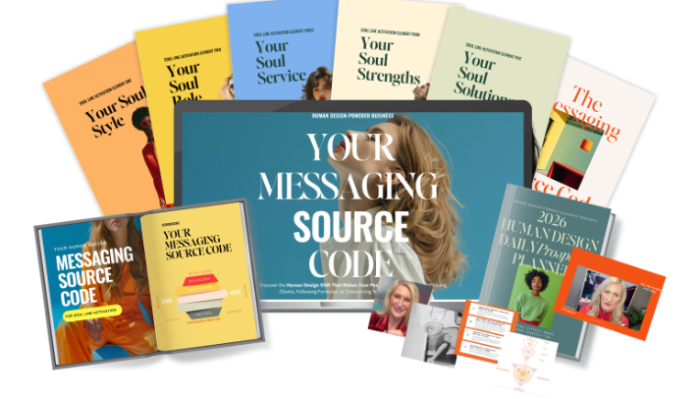
That is the central question behind Victoria Gibson’s Messaging Source Code.
This program takes a different route from conventional messaging courses. Instead of beginning with a universal sales script or a collection of headline formulas, it uses Human Design as a framework for exploring personal communication, business positioning, strengths, and the type of value a person wants to bring to their audience.
The aim is to help entrepreneurs develop a message that feels more personal and recognizable, while still connecting with the needs and interests of potential clients.
It is a program about finding the substance behind your message before deciding how to communicate it.
The messaging problem: when your marketing sounds borrowed
A business can have a good offer and still struggle to explain why someone should choose it.
This often happens when its communication is built almost entirely around external advice.
One expert recommends using a particular content formula. Another suggests changing the niche. Someone else says to publish more frequently, use stronger sales language, or follow a specific launch strategy.
There is nothing inherently wrong with learning from other marketers. The difficulty begins when every new recommendation changes the way you present your business.
Your website starts to sound different from your social content. Your offer description feels disconnected from the way you actually work with clients. Even when you have something valuable to say, the words do not quite feel like yours.
Messaging Source Code approaches this issue through the idea of alignment: understanding your own communication patterns and using that understanding to shape your business message.
The program’s Human Design framework is intended to help participants explore five areas of their identity and work. Each area has a different role in the overall messaging process.
Inside the Messaging Source Code: five activation elements
The official program is organized around five named elements. Rather than treating them as five unrelated lessons, it presents them as connected parts of a broader messaging and positioning framework.
1. Soul Style – Understanding how your message comes across
The first element is Soul Style.
This part focuses on the way you naturally express yourself and the impression your communication creates. It asks you to look beyond the words you use and consider the overall quality of your message.
For example, two consultants may offer almost identical services but communicate in very different ways. One may be direct, analytical, and structured. Another may be expressive, conversational, and driven by personal stories.
Neither approach is automatically better. The important question is whether the communication style is recognizable, appropriate for the audience, and consistent with the person behind the business.
The Soul Style guidebook and training are intended to help participants understand this aspect of their messaging through the program’s Human Design interpretation.
For a business owner who has spent years trying to imitate another person’s marketing voice, this can be a useful point of reflection.
2. Soul Role – Clarifying the role you play for your audience
The second element is Soul Role.
People do not choose a coach, consultant, educator, or service provider solely because of the information they share. They also respond to the kind of guidance, perspective, and support that person brings.
Consider a business mentor who helps clients make decisions during periods of uncertainty. Their value may involve more than delivering a marketing strategy. They may also help people see the bigger picture, recognize overlooked opportunities, or approach a difficult decision with greater confidence.
Soul Role is presented as a way to explore the role you naturally occupy in the relationship with your audience.
The program’s material connects this element with trust, recognition, and the way an entrepreneur communicates their contribution.
In practical terms, it encourages a more thoughtful question than “What should I post today?”
It asks you to consider: “What do people need to understand about the role I play in helping them move forward?”
3. Soul Service – Finding the deeper purpose behind your work
The third activation element is Soul Service.
A service description usually explains what a business provides. But the deeper value of that service is often found in the change it is intended to create.
A designer might create websites, but the larger contribution could be helping a small business present itself with greater confidence. A business consultant might provide strategy sessions, but the value may lie in helping a founder make decisions and move through a difficult stage of growth.
Soul Service explores the perspective, purpose, and contribution behind the work.
According to Victoria Gibson’s official description, this element is intended to help participants identify the heart of their message and communicate the service they are here to provide.
This can be particularly relevant when a business has outgrown its original niche or when its existing website and marketing no longer reflect the work it wants to be known for.
The objective is not simply to find a more attractive tagline. It is to understand the larger idea that connects your experience, service, and audience.
4. Soul Strengths – Recognizing the value beyond your job title
The fourth element is Soul Strengths.
Business owners often describe themselves through familiar labels: coach, strategist, designer, consultant, educator, or agency owner.
Those labels explain what someone does, but they do not always communicate why their contribution is different.
Two people can share the same professional title and still have completely different ways of solving problems, guiding clients, and delivering value.
Soul Strengths focuses on identifying the qualities and capabilities that shape the way you influence your audience.
The official program describes this as an exploration of the energetic architecture behind how you impact your people, rather than simply listing your professional expertise.
For messaging purposes, this distinction matters. A business becomes easier to describe when it can explain not only the service being offered, but also the particular strengths and perspective behind that service.
The resulting insights can be considered when developing an about page, offer description, personal brand introduction, or content themes.
5. Soul Solutions – Connecting your perspective with your offers
The fifth element is Soul Solutions.
This part brings the framework closer to business offers and the problems an entrepreneur chooses to solve.
A business owner may have years of experience across several subjects. However, not every area of expertise needs to become an offer, a service, or a central part of their marketing.
The challenge is deciding which problems to focus on and how to communicate the value of the solutions.
Victoria Gibson presents Soul Solutions as a way to explore the areas of influence and wisdom that can shape offers and attract the right audience.
The intended connection is between what you understand, what your audience needs, and the solutions you choose to bring to the market.
For example, a consultant might have experience in marketing, operations, and team development. The Soul Solutions exercise can be used as a prompt to examine which parts of that experience are most meaningful to the work they want to build.
It is still important to validate any offer with real customer needs, market research, and business judgment. A personal framework should support those decisions, not replace them.
The Messaging Source Code guide: bringing the five elements together
One of the main resources advertised on Victoria Gibson’s official page is a customized Messaging Source Code guide of more than 100 pages.
The guide is described as being delivered in five installments, corresponding to the program’s five activation elements.
This is an important part of the offer because the program is not positioned as a collection of generic messaging worksheets that every participant receives in exactly the same form.
The official description says the material is synthesized around the participant’s Human Design and delivered as personalized guidance.
The guide is intended to serve as a reference for business communication and positioning. Instead of repeatedly starting from scratch when writing content or refining an offer, participants can return to the insights and use them as a starting point.
For someone who regularly changes their website copy, social media direction, and service descriptions, having a central reference may help bring more consistency to the process.
The actual usefulness of a personalized guide will depend on the quality of the interpretation and how thoughtfully its suggestions are applied.
Training and coaching: applying the framework to business communication
Messaging Source Code is described on the official page as more than a Human Design introduction.
Victoria positions it as a business messaging activation program, with guidebooks, training, and coaching attached to the five elements.
The purpose is to connect the framework with practical business decisions.
Some of the areas the program says it addresses include:
- Understanding which communication platforms may suit your approach.
- Developing a more recognizable personal brand.
- Clarifying your positioning and niche.
- Identifying the strengths behind your work.
- Understanding how to communicate your service and perspective.
- Exploring offer ideas connected to your areas of expertise.
- Developing content and messaging that feel more consistent with your identity.
The official page describes the five elements as customized guidebook and training experiences, with coaching included for several elements.
It also advertises a complete guide delivered in five installments. The exact coaching schedule, delivery dates, and availability of direct support should be checked against the current enrollment terms rather than assumed for every version of the program.
What makes this different from a traditional copywriting course?
This is an important distinction for anyone considering the program.
A conventional copywriting course might focus on headlines, sales-page structure, email sequences, persuasion principles, calls to action, and conversion-focused writing.
Messaging Source Code takes a different starting point.
Its foundation is Human Design and the idea that an entrepreneur’s communication and business positioning can be explored through their individual design.
That means its main emphasis is on self-understanding, message clarity, identity, and positioning rather than teaching a complete technical copywriting system.
The two approaches can complement one another. A business owner may use the program’s insights to clarify what they want to communicate, then use established copywriting principles to organize that message into a landing page, email, or sales presentation.
However, someone looking specifically for detailed instruction in direct-response copywriting, SEO writing, paid advertising, or email automation should understand that those are not the central focus of this program.
Who might benefit from Messaging Source Code?
The program is primarily aimed at entrepreneurs who already have something meaningful to communicate but want greater clarity about how they present it.
Coaches and consultants
People selling expertise-based services may find the positioning exercises relevant when explaining what makes their approach different from other providers.
Personal brand entrepreneurs
Creators and business owners who build their business around their experience, perspective, and personality may appreciate the focus on recognizable communication.
Established service providers
Those who have changed their offers or audience over time may use the framework as an opportunity to revisit their message and business direction.
Course creators and educators
People who teach, train, or guide others may find the five elements useful as prompts for clarifying their subject, perspective, and audience.
Entrepreneurs tired of generic marketing formulas
If you have tried several messaging approaches but still feel disconnected from your marketing, the program’s identity-led approach may be worth exploring.
The official page also says that prior Human Design knowledge is not required. It presents the material as a business-focused synthesis rather than a course that expects participants to master the full Human Design system.
A few things to understand before purchasing
Messaging Source Code uses Human Design as its central interpretive framework. Human Design is a spiritual and self-development system; its claims about personality, energy, and business suitability are not scientifically established methods for predicting communication ability, attracting clients, or achieving business success.
It is best to approach the framework as a personal reflection and positioning tool rather than as a scientifically validated business assessment.
There are also practical considerations:
- Personalized material: Confirm what information is required to prepare your customized guidebooks and how they are delivered.
- Coaching access: Check whether the version being offered includes live coaching, recordings, or another form of support.
- Program schedule: Verify current delivery dates and whether the program is open for enrollment.
- Digital resources: Confirm that the guidebooks, training, and any supporting materials advertised are included in your specific purchase.
- Business outcomes: Treat statements about attracting clients, increasing income, or improving sales as promotional possibilities rather than guaranteed results.
The official page currently presents the program through its five activation elements and describes a 100+ page personalized guide. Its enrollment and notification information should be checked directly for current availability.
Final perspective: clarity before louder marketing
Messaging Source Code is built around a question that many business owners eventually face: how can you communicate your value without feeling as though you are constantly trying to become someone else?
Its five-part structure explores personal communication style, business role, service, strengths, and solutions through the lens of Human Design.
That makes it different from a standard collection of copywriting templates. The emphasis is on understanding the person and perspective behind the business, then using those insights to inform positioning and marketing decisions.
For entrepreneurs who enjoy reflective approaches to business development and want a more personal starting point for their messaging, the program may offer useful ideas to work with.
It is not a substitute for market research, customer conversations, strong offer development, or proven marketing fundamentals. Those still matter. But a clearer understanding of what you want to say can make those activities more focused.



Reviews
There are no reviews yet.