
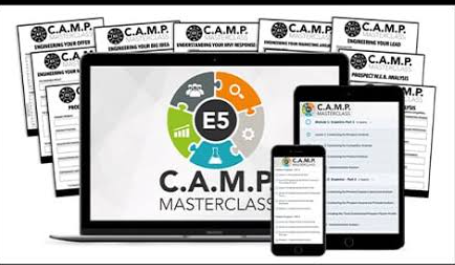

Todd Brown – E5 Method 2025
A Structured Approach to Building Marketing Campaigns That Convert
Getting people to notice a business is one challenge. Giving them a compelling reason to become customers is another.
A company can spend time creating content, testing advertisements, improving its website, and sending email campaigns, yet still find that its marketing feels disconnected. One campaign attracts leads but produces few sales. Another generates interest but fails to communicate why the offer is different. Often, the missing piece is not another marketing channel. It is the thinking behind the campaign itself.
That is the problem Todd Brown’s E5 Method is designed to address.
The E5 Method 2025 training focuses on the strategy and construction of customer-acquisition campaigns. Instead of treating advertising, copywriting, funnels, and offers as separate activities, it brings them together in a structured process known as E5 C.A.M.P.
The framework gives marketers a way to examine their marketplace, engineer a compelling offer and message, evaluate campaign performance, enhance conversions, and expand customer acquisition.
What Is Todd Brown’s E5 Method?
Todd Brown is known for his work in direct-response marketing, marketing strategy, and campaign development. His E5 framework emphasizes understanding what motivates prospective customers before trying to persuade them to buy.
The underlying philosophy is that an effective campaign should not begin with a headline or an advertisement. It should begin with research.
A marketer needs to understand the audience, the problem they want solved, the alternatives they have considered, and the reasons they might choose one solution over another. That information can then influence the product, offer, big idea, and marketing message.
The E5 framework organizes this work into five stages:
- Examine – Research the marketplace, prospect, competitors, and product.
- Engineer – Develop the offer, big idea, marketing thesis, message, and funnel.
- Evaluate – Test the campaign and understand its response.
- Enhance – Improve conversions through testing, follow-up, and additional offers.
- Expand – Build on campaign performance and increase customer acquisition systematically.
This structure is the foundation of the 2025 training.
Stage 1: Examine – Understand the Market Before Writing the Campaign
A marketing message is only as relevant as the research behind it. If a business misunderstands its audience, even professionally written copy may fail to connect.
The Examine stage focuses on gathering information about the marketplace and the people within it.
The published curriculum includes prospect analysis, competitor analysis, and product analysis. These exercises help marketers look at the business from the customer’s point of view rather than relying entirely on assumptions.
Topics include:
- Identifying the ideal client or customer.
- Understanding customer problems and desired outcomes.
- Analyzing competitor campaigns.
- Reviewing product features and benefits.
- Examining the prospect’s current situation and desired future.
- Studying the awareness level of potential customers.
- Understanding how the marketplace perceives different promises.
The training also introduces tools such as the Promise Exposure Spectrum, Prospect Awareness Pyramid, and three-dimensional prospect profile.
For example, a business selling a productivity product might discover that its audience is not simply looking for another planning tool. Customers may actually want fewer missed deadlines, less mental clutter, and more control over their workday.
That difference can influence the entire campaign.
Stage 2: Engineer – Build the Offer and Marketing Message
Once the research is complete, the next challenge is turning those insights into a compelling campaign.
The Engineer stage focuses on constructing the marketing assets that connect the customer’s desire with the product or service being offered.
This is where the training moves into offer development, marketing strategy, and copywriting.
Engineering the Offer
A product’s features do not automatically make it attractive. The offer needs to communicate why the solution matters and what makes it worth considering.
The original curriculum includes lessons on engineering a customer-generating product and developing an effective offer.
The work involves considering the value being presented, the desired outcome, and the way the offer is positioned in the market.
Developing the Big Idea
A big idea gives a marketing campaign its central concept. It provides a way to communicate the product’s value through a message that is easier for the intended audience to understand and remember.
The E5 curriculum includes dedicated training on engineering the perfect big idea and marketing thesis.
This is especially relevant for marketers who find themselves writing advertisements or sales pages that sound similar to every competing offer.
Writing the Marketing Message
The Engineer stage also covers campaign copywriting, headlines, leads, and marketing arguments.
Published lessons include:
- Flawless funnel copywriting.
- Engineering the perfect headline.
- Developing the marketing message.
- Constructing the marketing argument.
- Creating a clear campaign thesis.
- Using a unique mechanism in the marketing message.
The purpose is to connect the prospect’s existing interests with the reason the product deserves consideration.
Stage 3: Evaluate – Test Before You Scale
A campaign should not be judged only by how good it looks or how much effort went into creating it.
The Evaluate stage focuses on testing the minimum viable funnel and understanding how the market responds.
The original training includes lessons on testing a Minimum Viable Funnel (MVF) and interpreting its response.
This part of the process is important because it encourages marketers to use actual campaign feedback rather than making decisions based entirely on personal preference.
For example, a sales page might receive a healthy amount of traffic but generate very few orders. That result could point toward a problem with the offer, the message, the audience, or the buying process.
The training’s evaluation approach provides a framework for examining campaign performance before making larger investments.
Stage 4: Enhance – Improve the Performance of the Campaign
Once a campaign has been tested, the next step is to identify opportunities for improvement.
The Enhance stage focuses on increasing the effectiveness of the marketing system. Its published curriculum includes conversion improvements, testing protocols, upsell sequences, and follow-up sequences.
Some of the topics covered include:
- Improving overall campaign conversions.
- Developing an upsell sequence.
- Creating effective follow-up sequences.
- Extending the opportunity for prospects to engage with an offer.
- Using structured testing to improve campaign performance.
This stage is particularly relevant to businesses that already have traffic and leads but want to make better use of the attention they are receiving.
A well-planned follow-up sequence, for example, can give interested prospects additional information and opportunities to make a decision instead of relying on a single visit to a sales page.
Stage 5: Expand – Develop a More Scalable Acquisition System
The final stage focuses on expanding a campaign that has been evaluated and improved.
Rather than increasing advertising spend without understanding the numbers, the framework encourages marketers to examine performance and identify opportunities for growth.
The original curriculum includes topics related to acquisition aggression, competitive analysis, tracking, metrics reporting, and backend marketing.
The published lessons also reference the B.A.C.O. framework as part of the expansion process.
This stage brings the earlier work together. Market research informs the offer, the offer informs the message, the message is tested through the funnel, and the campaign is improved before expansion.
The goal is to make growth decisions using a clearer understanding of the marketing system.
Funnel Building and Copywriting Resources
The E5 Method 2025 is not limited to high-level marketing concepts. Its original curriculum includes practical lessons on building the assets needed for a customer-acquisition campaign.
The training describes a Minimum Viable Funnel approach and covers several important funnel components:
- Traffic capture pages.
- Marketing and sales pages.
- Headlines and leads.
- Order forms.
- Funnel copywriting.
- Testing and campaign evaluation.
These subjects are useful for marketers who want to understand how the individual parts of a funnel work together.
The original 2025 offer also advertised three additional resources:
The Ultimate 6 Funnels Template Set: A collection of funnel templates intended to provide campaign models for learners to study and adapt.
The Ultimate 15 Email Sequences Swipe File: Email-sequence examples designed to help marketers study follow-up and campaign communication.
The Ultimate Director’s Cut Funnel Package: Marketing campaign breakdowns showing how selected campaigns were constructed and presented.
These bonuses were part of the advertised 2025 offer. Their inclusion in another version, membership, or third-party package should not be assumed.
Who Is the E5 Method 2025 For?
The training’s subject matter may be relevant to several types of professionals.
Entrepreneurs and business owners: People who want to build a more structured approach to attracting customers and communicating the value of their products.
Direct-response marketers: Marketers interested in campaign research, offer positioning, persuasive messaging, and conversion optimization.
Copywriters: Writers who want to understand the research and strategy behind effective sales copy rather than focusing only on individual headlines or emails.
Funnel builders: Professionals responsible for creating landing pages, sales pages, order forms, and follow-up systems.
Consultants and service providers: Business owners who need a clear way to explain their services, develop offers, and create a repeatable client-acquisition process.
The program is most relevant to people willing to work through research, campaign development, and testing. It should not be treated as a shortcut that automatically produces sales.
What Makes the E5 Framework Worth Studying?
The strongest feature of the E5 approach is its sequence.
Many marketers learn copywriting, advertising, funnel development, and analytics separately. The challenge is knowing how to connect them when building a real campaign.
E5 provides a framework for bringing those activities together. It starts with understanding the customer and marketplace, moves into offer and message development, and then introduces evaluation, enhancement, and expansion.
This makes the program particularly interesting for people who want to understand the strategic reasoning behind a campaign, not simply copy a collection of templates.
The emphasis on market research is also valuable. Businesses can spend considerable time refining their advertising while overlooking the basic question of whether their message reflects what customers actually care about.
Final Thoughts
Todd Brown’s E5 Method 2025 offers a structured look at direct-response customer acquisition. Its five stages provide a framework for moving from market research to offer development, funnel creation, testing, conversion improvements, and campaign expansion.
The curriculum’s combination of strategic lessons, worksheets, funnel training, and copywriting topics makes it relevant to marketers who want to understand how a complete campaign is put together.
It is best approached as a marketing education program that requires research, implementation, and ongoing testing. The framework can help organize campaign decisions, but actual business results depend on the product, audience, market conditions, execution, and available resources.
Frequently Asked Questions
1. What is Todd Brown’s E5 Method 2025?
The E5 Method 2025 is a direct-response marketing training program built around a five-stage customer-acquisition framework: Examine, Engineer, Evaluate, Enhance, and Expand.
2. What does E5 C.A.M.P. stand for?
It refers to Todd Brown’s E5 customer-acquisition marketing framework. Its five stages guide the process from marketplace research and campaign development through testing, optimization, and expansion.
3. What are the five stages of the E5 Method?
The five stages are Examine, Engineer, Evaluate, Enhance, and Expand. Each stage addresses a different part of developing and improving a marketing campaign.
4. Does the course teach sales funnel creation?
Yes. The published curriculum includes minimum viable funnel development, traffic capture pages, marketing and sales pages, order forms, and funnel copywriting.
5. Does the E5 Method include copywriting training?
The curriculum covers headlines, leads, marketing arguments, campaign messages, and funnel copywriting. It also explores the strategic research that informs those materials.
6. What is the purpose of the Examine stage?
Examine focuses on understanding the marketplace, prospects, competitors, and product. The goal is to gather useful information before developing the campaign.
7. Does the training cover email marketing?
The 2025 offer advertised a 15-email-sequence swipe file as a bonus. The broader curriculum also covers follow-up sequences as part of campaign enhancement.
8. Who can benefit from the E5 Method?
Entrepreneurs, business owners, copywriters, funnel builders, consultants, and direct-response marketers may find its customer-acquisition framework relevant.



Reviews
There are no reviews yet.