
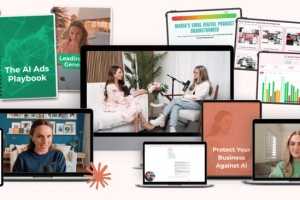

Maria Wendt – AI Money Maker: Create and Sell Digital Products With AI
Turn Your Ideas Into Digital Products People Can Actually Use
Artificial intelligence has changed the way people approach online business. Tasks that once required hours of brainstorming, writing, research, and product development can now be approached with AI-assisted workflows. But having access to AI tools is only part of the equation. The bigger question is how to use them to create something genuinely useful for an audience.
That is where Maria Wendt – AI Money Maker comes in.
This course explores how entrepreneurs and digital creators can use AI to develop digital products, build simple AI-powered tools, improve marketing workflows, and find new ways to add value to their existing offers. Instead of treating artificial intelligence as just another technology trend, the training looks at how it can become part of a practical product-development and marketing process.
The concept is straightforward: identify a problem your audience needs help solving, explore how AI could support a solution, develop a useful product or tool, and consider how to package and market it as part of your business.
You do not necessarily need to be a programmer to begin exploring these ideas. The course emphasizes using AI assistants and guided prompts to help with product creation, making the subject relevant to creators who have ideas but may feel intimidated by technical development.
Whether you sell digital downloads, educational resources, online courses, templates, or services, AI Money Maker offers a framework for thinking about how AI-generated products could fit into your business model.
What Is the AI Money Maker Course About?
AI Money Maker is a digital business and AI training program created by Maria Wendt. Its main focus is using AI to create and sell digital products and tools, while also exploring how AI can support marketing, advertising, content production, and customer value.
One of the central ideas is that you do not always need to build a complicated software application to create something useful. A focused tool that helps someone complete a specific task, make a decision, organize information, or generate ideas can be valuable when it addresses a real need.
For example, a content creator might develop a tool that helps organize video ideas. A coach could explore an AI-assisted resource that helps clients plan their weekly activities. A marketer might create a brainstorming assistant tailored to a particular audience.
These examples illustrate possible applications of the course’s concepts rather than guaranteed products or outcomes.
The training also considers how these tools might be used in different parts of an online business. A digital product can potentially be sold independently, included as a bonus, offered as an upgrade, or used to introduce customers to a more comprehensive product.
This makes the subject relevant not only to people starting from scratch but also to business owners who already have products and want to explore new ways to improve their customer experience.
Discover Practical Ways to Create Digital Products With AI
Coming up with a product idea is often easier than turning it into something people can use. You might have a list of ideas saved on your computer, but deciding which one to develop, how to structure it, and what the final product should do can quickly become overwhelming.
AI Money Maker focuses on using AI assistants to help move from an initial idea toward a working digital product.
The course describes a process in which you communicate what you want a tool or product to accomplish and use an AI assistant to help with its creation. This approach can make experimentation more approachable for people who do not have traditional coding experience.
Rather than beginning with a complex technical project, you can start by defining a specific problem and describing the outcome you want the product to support.
A useful starting point is to ask yourself three questions:
- What problem does my intended audience regularly encounter?
- Could a simple digital resource or AI-assisted tool make that task easier?
- How would someone use the finished product in their everyday work?
These questions help keep product development connected to real customer needs instead of creating something simply because AI makes it possible.
The course also presents AI tool and digital product ideas across different niches, which can help when you are unsure where to begin. The important part is to evaluate those ideas for your own audience, check whether similar solutions already exist, and decide what would make your version useful.
Explore AI Tools Without Starting With Traditional Coding
You do not need to become a software engineer before experimenting with every kind of AI-powered product. Modern AI assistants can help people plan, draft, test, and refine certain tools using natural-language instructions.
AI Money Maker introduces this approach through step-by-step tutorials that demonstrate how AI can assist with creating digital products and tools. The official course page emphasizes a workflow that does not require coding experience and says that new monthly subscriptions are not necessary for the demonstrated approach.
That does not mean every AI product can be built without technical knowledge or additional costs. Some ideas may require external platforms, integrations, hosting, paid features, or further development. The resources needed will depend on the product you want to create.
For a beginner, however, learning how to explain a product idea clearly to an AI assistant can be a useful starting point.
You can define the intended user, describe the task, specify the information the tool should accept, and outline the result it should provide. You can then review the output, test different scenarios, identify errors, and refine the instructions.
This process encourages experimentation while reminding you that AI-generated output still needs human judgment. A tool that looks impressive in a demonstration may need additional testing before it is suitable for customers.
Find Product Opportunities in Your Existing Business
Not every new product needs to be a completely separate business. In some cases, the most practical opportunity may be to improve something you already sell.
AI Money Maker explores how AI implementation tools can complement existing digital products and customer offers. This is particularly relevant to creators who have an established audience, an online course, a membership, or a service-based business.
Imagine that you sell a training program. Customers may appreciate a planning assistant, an idea generator, or a checklist that helps them apply what they learn. A marketer might offer a tool that helps users organize campaign concepts. A consultant could explore a guided resource that helps clients prepare for a working session.
These additions can make a broader offer more interactive or easier to use when they genuinely support the customer’s goal.
The course also discusses using AI tools as standalone products, order bumps, upsells, or complementary resources. Each option serves a slightly different purpose.
- Standalone products: Offer a focused tool that solves a specific problem.
- Order bumps: Give customers an optional, relevant addition during checkout.
- Upsells: Present a suitable next step for customers who want more support.
- Product enhancements: Add useful functionality to an existing course, service, or digital resource.
- Lead magnets: Offer a helpful free resource that introduces people to your wider work.
The right approach depends on your audience, pricing, product quality, and business model. Adding more products does not automatically increase revenue; the additions need to make sense for the people buying them.
Use AI to Support Content and Marketing
Creating a product is only one part of running an online business. People also need to discover it, understand its value, and decide whether it is right for them.
The course covers ways AI can support marketing and sales activities, including content creation, advertising workflows, organic marketing, research, trend analysis, and launch planning.
These applications can help you organize ideas and work through repetitive tasks. For example, AI may assist with generating initial content angles, grouping customer questions, outlining promotional campaigns, or adapting a central idea for different marketing channels.
However, effective marketing requires more than producing a large volume of content.
Your messaging should reflect your audience’s concerns, explain the purpose of your offer, and give people a clear reason to pay attention. AI can help with brainstorming and drafting, but it cannot replace your responsibility to check facts, understand your customers, and maintain a consistent brand voice.
AI Money Maker also addresses the use of AI in content creation, with an emphasis on creating material that feels engaging and relevant rather than generic. This is an important distinction for businesses that want to use automation without losing the personality and expertise that make their work recognizable.
Before publishing AI-assisted content, review it carefully. Remove repetitive wording, correct inaccurate statements, add meaningful context, and make sure the final material serves the reader rather than simply filling a content calendar.
Understand AI-Assisted Advertising and Campaign Planning
Advertising is another area covered in the program. The course introduces Maria Wendt’s approach to using AI within advertising and broader marketing workflows.
AI can help with tasks such as brainstorming creative angles, organizing audience research, drafting initial ad variations, and reviewing campaign information. These uses can make the preparation process more structured, particularly when you are managing multiple products or campaigns.
For example, a business owner might use AI to develop several versions of a message for different audience segments. Those drafts can then be reviewed, adjusted, and tested against the actual goals of the campaign.
AI-assisted research can also help you organize information about customer questions, common objections, and potential positioning ideas.
It is still important to distinguish between generating ideas and proving that an advertisement will perform well. Real campaign performance depends on factors such as the offer, audience, creative quality, budget, competition, landing page, and ongoing optimization.
The course provides insight into how AI fits into the creator’s marketing process, but individual businesses need to test their own campaigns and make decisions based on reliable results rather than assumptions.
Make Better Use of Prompts and AI Workflows
A common frustration with AI is receiving answers that sound generic or do not solve the problem you had in mind. Often, the issue is not simply which AI tool you use, but how clearly you explain the task and evaluate the result.
AI Money Maker emphasizes guided prompts and step-by-step workflows to help make product creation more manageable.
A well-designed prompt should provide enough context for the AI assistant to understand the intended user, the problem being addressed, the format required, and the limitations it should follow.
For instance, instead of asking for a generic marketing tool, you might describe the audience it serves, the information users will provide, the type of output they need, and what a successful result should look like.
You can then review the first output, identify missing elements, and refine the instructions.
This iterative approach is more realistic than expecting a perfect product from a single prompt. Testing, editing, and checking the output are important parts of the process, especially if customers will rely on the tool for business decisions.
The course’s emphasis on guided AI workflows may be helpful for people who want a more organized starting point rather than collecting disconnected prompts without knowing how to apply them.
Think Beyond One Product or One Launch
A digital product can sometimes serve more than one purpose within a business. Once you have identified a useful customer problem and developed a suitable solution, you can consider how that solution fits into your wider product ecosystem.
AI Money Maker explores several ways digital products and AI tools can be incorporated into a broader business strategy.
A small tool might work as an entry-level purchase. A related resource could complement a larger course. A useful free tool might introduce potential customers to your expertise, while an advanced product offers additional guidance.
The key is to create a logical connection between the products. Customers should understand why the additional resource exists and how it relates to the outcome they want.
This approach also gives you a reason to think carefully about product maintenance. If your tool depends on external AI services, prompts, data, or integrations, you may need to review it periodically to ensure it continues to work as intended.
A product is not finished simply because the first version has been created. Customer feedback, usability testing, and ongoing improvements can all contribute to a more useful experience.
Who Is AI Money Maker For?
AI Money Maker may be relevant to several types of online business owners.
Digital product creators can explore ways to develop new resources, tools, and product ideas with AI assistance.
Coaches and consultants may find ideas for creating practical resources that support their clients between sessions or complement an existing service.
Content creators and marketers can explore how AI fits into brainstorming, content production, advertising preparation, and marketing workflows.
Online course creators may be interested in adding interactive tools, useful bonuses, or complementary resources to their educational products.
Entrepreneurs exploring AI can use the training as a starting point for understanding how AI-assisted product development may fit into a digital business.
The course may also be useful for people who have plenty of ideas but struggle to turn them into practical products. A structured process can help narrow the possibilities and focus attention on one achievable project at a time.
Some familiarity with online business and digital products may be helpful, but the course’s stated no-coding approach is intended to make its product-creation methods more approachable for beginners.
What Should You Know Before Getting Started?
It is worth approaching AI product development with realistic expectations.
First, a tool that is easy to create is not necessarily easy to sell. People need a reason to use it, and the product should offer a clear benefit compared with alternatives.
Second, AI-generated content and tools need review. Check factual accuracy, usability, privacy considerations, and any limitations that could affect the customer experience.
Third, market research remains important. Before investing significant time in a product, investigate whether your audience actually wants it and whether your proposed solution addresses a meaningful problem.
Finally, revenue is not guaranteed. The course is educational, and results will vary depending on factors such as experience, implementation, demand, pricing, and marketing. Examples of successful products or campaigns should not be treated as typical outcomes.
These considerations do not make AI product development less interesting. They simply help keep the focus on building something useful rather than assuming that using AI alone will create a profitable business.
Final Thoughts: A Practical Starting Point for AI-Powered Product Creation
The opportunity with AI is not limited to using a chatbot to write faster. For digital entrepreneurs, it also involves reconsidering how products are researched, developed, packaged, and marketed.
Maria Wendt – AI Money Maker explores that wider picture through AI-assisted digital product creation, simple tool development, prompts and workflows, marketing applications, advertising, and ways to add value to existing offers.
Its practical focus may appeal to people who want to experiment with AI without beginning with traditional software development. It also gives established creators ideas to consider when expanding a product range or improving the resources they provide to customers.
The most useful starting point is to choose one audience, identify one genuine problem, and explore a solution that can be tested and improved. From there, you can decide whether the product belongs in your existing business, works as a standalone offer, or could support a broader customer journey.
AI can help you move from an idea to an early version more efficiently, but the quality of the final product still depends on your decisions, testing, and understanding of the people you want to serve.
If you want to learn how AI can become part of a digital product and marketing workflow, AI Money Maker offers a focused introduction to the possibilities and practical considerations involved.




Reviews
There are no reviews yet.