
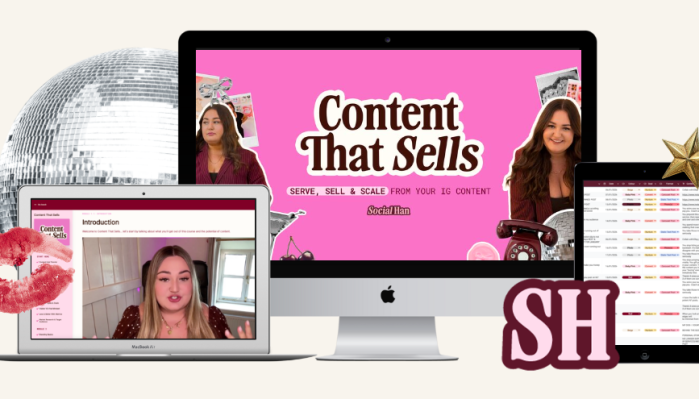

Han Mosby – Content That Sells: Stop Posting Just to Stay Visible
There’s a particular kind of frustration that comes from spending hours creating Instagram content and then seeing very little happen.
You plan the carousel, rewrite the caption, adjust the graphics in Canva, and finally publish the post. Maybe it gets a few likes. Perhaps someone leaves a nice comment. But when you look at your actual business, the enquiries haven’t changed much.
It’s easy to assume the solution is to post more frequently, follow the latest trend, or find a better hook.
Han Mosby’s Content That Sells approaches the problem from a different direction. The course focuses on the connection between content, messaging, audience understanding, and sales. Its central premise is that social media content should have a job beyond filling up a publishing calendar.
For coaches and service providers, that means learning to communicate what they do, who they help, why their work matters, and how someone can take the next step.
First, get clear on what you’re actually selling
Before planning a month of Instagram posts, there’s a more useful question to answer:
Do your potential customers understand the value of your offer?
A business might have an excellent service but struggle to explain it in a way that makes sense to its audience. The content may look polished, yet the messaging doesn’t give people a clear reason to enquire.
The opening part of Content That Sells addresses this foundation through topics such as:
- Sales method and offer positioning
- Understanding client capacity
- Fluff-free sales messaging
- Low-ticket versus high-ticket offers
- Different content types and their goals
- The difference between visibility and virality
- Measuring performance instead of relying on guesswork
- Market research and target audience understanding
One particularly practical idea is connecting sales goals with delivery capacity. There’s little benefit in building a content strategy around attracting more clients if the business hasn’t considered how many clients it can realistically serve.
This makes the planning process more commercially focused. Content isn’t separated from the business behind it.
Build a recognizable presence without copying everyone else
Instagram is full of businesses using similar graphics, trending audio, recycled hooks, and familiar caption formulas.
That can make it difficult for a service provider to develop a recognizable voice.
The branding section of the course moves into the visual and presentation side of content. Publicly listed lessons include branding basics, feed aesthetics, posting patterns, design principles, social media graphics, feed curation, and signature content style.
These subjects are useful for someone who wants their profile to feel more consistent without turning every post into a lengthy design project.
The goal isn’t necessarily to make every graphic look identical. It’s to create a recognizable presentation that supports the message and helps the right audience understand the brand.
Topics covered in this area include:
- Basic brand presentation
- Feed layout and visual consistency
- Social media graphic design
- Design decisions and common mistakes
- Creating a signature content style
- Developing more intentional posting patterns
For business owners who spend too much time adjusting fonts, colours, and layouts, this part of the curriculum is particularly relevant.
The content planning section: give every post a reason to exist
A useful content calendar shouldn’t be a random list of topics.
A post designed to introduce your business has a different purpose from one that answers an objection. A personal story has a different role from a direct promotional post. And a conversion-focused piece of content should make the next step clear.
Content That Sells organizes several of these ideas around different content purposes.
The publicly described curriculum includes:
Evergreen content
Create material that remains useful beyond the day it is published. Evergreen topics can help communicate expertise and answer recurring questions without depending entirely on current trends.
Pain-point marketing
Understand the challenges your audience experiences and communicate them thoughtfully. The objective is to show that you understand the problem rather than rely on exaggerated fear or pressure.
Growth content
Develop posts intended to introduce your work to people who may not know your business yet.
Nurture content
Build familiarity and trust by sharing useful information, perspectives, explanations, and experiences.
Conversion content
Make your offer easier to understand and give interested followers a clear reason to enquire or purchase.
The course also includes a core quarterly content approach and content-system lessons. These topics connect individual post ideas to a more organized publishing process.
Better hooks, more thoughtful storytelling
Even a useful message needs a strong introduction.
The course includes dedicated topics around hooks, storytelling, calls to action, and caption length. These are important writing skills for anyone whose business depends on communicating through social media.
A hook should give the reader a reason to continue. It might introduce a problem, challenge an assumption, describe a familiar situation, or make a specific promise that the content can genuinely support.
Storytelling adds another dimension. Instead of presenting a service as a list of features, a business owner can use experiences, lessons, customer questions, and behind-the-scenes observations to make the message more relatable.
Calls to action then help connect the content to a practical next step.
The aim is not to make every caption sound like a sales pitch. It is to understand when a post should educate, when it should build a relationship, and when it should invite someone to take action.
Instagram Stories deserve their own strategy
Feed posts aren’t the only way to communicate with an audience.
Stories provide a different environment for sharing personal updates, answering questions, discussing offers, and maintaining contact with people who already follow a brand.
Content That Sells includes a separate Stories section, with publicly listed topics covering:
- The 80/20 Stories method
- Personal stories
- Promotional stories
- Building a Stories strategy
Separating personal and promotional content can help business owners think more deliberately about what they share.
For example, a personal story might communicate a value, experience, or lesson. A promotional story might explain a service, answer a buying question, share an offer, or invite an enquiry.
Rather than treating Stories as an occasional extra, this section presents them as another part of the overall content strategy.
Turn content creation into a repeatable workflow
One of the biggest challenges for independent business owners is consistency.
When content planning happens only when someone has free time, publishing can become unpredictable. A busy client week arrives, posts get delayed, and the business disappears from its audience’s attention.
The course’s content-system and planning topics are relevant to this problem. Its publicly listed curriculum also includes funnels and automations, repurposing top-performing content, and measuring success.
A more organized workflow can help a business owner:
- Keep content ideas in one place.
- Connect posts with specific offers.
- Plan different content purposes in advance.
- Reuse useful material in appropriate formats.
- Review performance and identify what deserves another look.
- Reduce unnecessary time spent creating every post from scratch.
The idea of repurposing is especially useful. A strong educational post might become a Story sequence, a short video topic, or a different piece of content addressing the same audience question.
Repurposing doesn’t mean repeatedly publishing identical material. It means getting more value from useful ideas while adapting the presentation to the format.
What is included in the course?
The publicly listed course outline describes a five-module learning structure with approximately 40 lessons. It also references a Content Hub and supporting marketing resources.
The advertised curriculum can be grouped into these five broad areas:
- Sales and content foundations: Sales method, client capacity, messaging, audience research, and content goals.
- Branding and presentation: Visual identity, feed aesthetics, design principles, and signature style.
- Content creation and conversion: Evergreen content, pain-point marketing, content planning, hooks, storytelling, captions, and calls to action.
- Instagram Stories: Personal stories, promotional stories, and a dedicated Stories strategy.
- Content optimization: Feed strategy, funnels, automations, repurposing, and performance metrics.
Exact lesson availability, resource files, and access arrangements should be checked against the version being sold.
Who is likely to benefit from Content That Sells?
This program is most relevant to people who already have a service, offer, or business idea and want their Instagram content to communicate its value more effectively.
Coaches and consultants may use the material to explain their approach, communicate expertise, and build trust with potential clients.
Creative professionals may find the branding, content presentation, and storytelling topics useful for showing their work and explaining their services.
Freelancers and independent service providers can explore ways to make their social presence more intentional instead of relying on occasional promotional posts.
Established online business owners may appreciate the focus on content systems, repurposing, and metrics when managing a more demanding publishing schedule.
It may be less suitable for someone looking for a technical advertising course, advanced paid-media training, or a program focused entirely on viral video production.
A sensible way to use what you learn
Don’t begin by trying to redesign your entire Instagram account.
Start with the offer. Write down what you sell, who needs it, what problem it addresses, and how many clients you can realistically serve. Then look at your existing content and identify whether it explains those points clearly.
Next, create a small selection of posts with different purposes:
- One post that introduces a common customer problem.
- One educational post that demonstrates your knowledge.
- One personal or behind-the-scenes story.
- One post that explains your offer.
- One direct invitation to enquire.
Review how people respond over time. Look beyond likes and views. Relevant enquiries, meaningful conversations, saves, and qualified interest can provide more useful feedback about whether your content is reaching the right people.
This is a more grounded approach than changing your strategy every time a new Instagram trend appears.
Final verdict
Han Mosby – Content That Sells is built around a straightforward but important distinction: social media content should support the business, not become a separate full-time job.
Its curriculum connects sales messaging, audience research, brand presentation, content planning, storytelling, Instagram Stories, funnels, and performance measurement. That combination makes it relevant to coaches and service-based entrepreneurs who want a more deliberate approach to marketing their offers.
The strongest appeal is its emphasis on creating content with intention rather than simply publishing more often. It encourages business owners to understand their audience, communicate clearly, and develop a repeatable content routine.
If your current Instagram activity feels disconnected from your sales process, the topics covered in this program offer a structured starting point for reviewing how you plan, write, and publish.


Reviews
There are no reviews yet.