
Brook Hiddink – High Ticket E-Commerce Program: Building an Online Store Around Premium Products
Imagine running an online store where a single order could be worth several thousand dollars.
You aren’t filling your catalog with hundreds of inexpensive products, trying to win customers through the lowest price, or constantly searching for the next viral item. Instead, you’re building a retail business around premium products, working with established suppliers, and creating a store that helps customers make considered purchases.
That is the business model at the center of Brook Hiddink’s High Ticket E-Commerce Program.
Brook Hiddink developed the program around high-ticket e-commerce, a form of online retail that focuses on selling more expensive products through relationships with brands and suppliers. The idea is to build a legitimate retail operation without necessarily purchasing and storing large quantities of inventory yourself. When a customer places an order, the retailer coordinates the purchase with the supplier, who handles product fulfillment according to the agreed arrangement.
It sounds straightforward when explained in a few sentences. The real work, however, happens behind the scenes: selecting the right products, getting approved by suppliers, understanding margins, building a trustworthy website, attracting qualified visitors, and managing customer orders.
The program is designed to teach those moving parts as one connected business process.
Start With the Product, Not the Website
A common mistake among new e-commerce entrepreneurs is spending too much time designing a store before deciding what the store should actually sell.
A polished Shopify website cannot fix an unsuitable product, weak supplier relationship, or market with little customer demand.
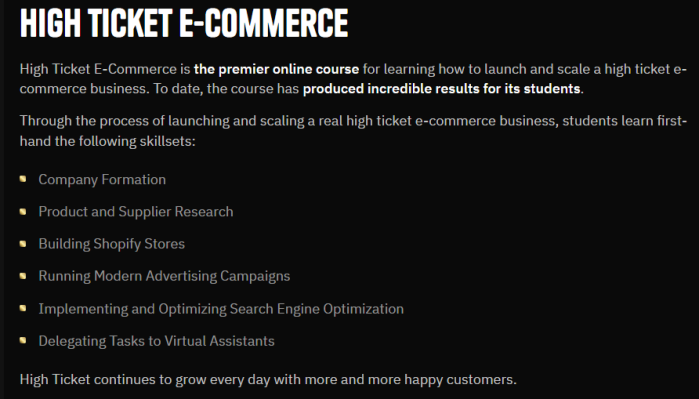
High Ticket’s official course description places product and supplier research among the core skills students learn. That makes sense because the product decision influences almost every other part of the business.
A premium product needs a clear market, a customer willing to consider a higher purchase price, and a supplier capable of supporting the retail relationship.
The research process involves looking beyond the advertised selling price. Entrepreneurs also need to understand:
- Whether there is genuine customer demand.
- How competitive the product category is.
- Which brands permit authorized online retail sales.
- What supplier requirements apply.
- Whether the expected margins support advertising and operating costs.
- How shipping, returns, warranties, and customer service are handled.
- Whether the product has enough commercial potential to justify building a dedicated store around it.
These questions are especially important in high-ticket retail because a large order value does not automatically mean a large profit.
The course’s product and supplier research focus gives learners a starting point for understanding these decisions before investing heavily in a store.
Finding Suppliers and Building Real Business Relationships
Supplier research is one of the most important parts of this business model.
In ordinary dropshipping, beginners often look for products through large marketplaces and third-party platforms. High-ticket e-commerce takes a different approach: the retailer seeks relationships with brands or authorized distributors that sell premium products.
That relationship can influence product availability, pricing, fulfillment arrangements, brand approval, and the ability to advertise particular products.
Brook Hiddink’s program identifies product and supplier research as a central skill. The official High Ticket platform also promotes Supplier HQ, a research resource intended to help users explore supplier information and organize their search.
A useful supplier evaluation process should consider:
Product suitability: Does the supplier offer products that fit the store’s intended market?
Retail approval: Does the company allow online retailers to advertise and sell its products?
Commercial terms: What are the pricing, payment, and margin arrangements?
Fulfillment: Who handles shipping, delivery communication, and damaged-product issues?
Customer support: How are warranties, returns, and after-sales questions managed?
Brand requirements: Are there restrictions on advertising, pricing, marketplaces, or website presentation?
These details are not minor administrative issues. They help determine whether a business can operate reliably after its first few orders.
Supplier approval is not automatic, and a research database should be treated as a starting point rather than a guarantee that every listed supplier will accept an application.
Turning the Research Into a Shopify Store
Once the product direction and supplier strategy are clearer, the next challenge is building the actual retail storefront.
The official course description lists Shopify store development among its core skill areas. This is an important part of the process because a high-ticket customer usually needs more information and reassurance before placing an expensive order.
A store selling premium products should do more than display a product photo and an Add to Cart button.
Customers may want to understand specifications, dimensions, available options, delivery expectations, warranty coverage, brand credibility, and the retailer’s customer-service process.
The website therefore needs to function as both a sales channel and a source of useful product information.
The store-building process may involve:
- Choosing an appropriate store name and domain.
- Organizing product categories.
- Creating clear product pages.
- Writing useful product descriptions.
- Adding relevant images and specifications.
- Configuring navigation and customer-service information.
- Setting up checkout and payment options.
- Making the website usable across desktop and mobile devices.
A professional appearance matters, but clarity matters just as much. A customer considering a premium purchase should be able to understand what is being sold, who is selling it, and what happens after an order is placed.
Getting Customers Without Depending on One Traffic Source
A store can have suitable products and reliable suppliers and still struggle if potential customers never find it.
Customer acquisition is therefore another major part of the High Ticket E-Commerce approach.
The official program identifies modern advertising campaigns and search engine optimization as core skills. These two areas can serve different purposes within the same business.
Paid advertising gives a retailer a way to introduce products to potential buyers and test different marketing approaches. SEO focuses on making the website easier to discover through relevant search queries.
For a premium retail store, search traffic can be particularly valuable because customers often research products before making a purchase. Someone comparing a product category, reviewing specifications, or searching for a particular brand may already have a clearer buying intention than someone casually browsing social media.
A store’s SEO work can include:
- Researching relevant product and category keywords.
- Writing informative product-page content.
- Organizing category pages around customer searches.
- Improving page titles and meta descriptions.
- Creating useful supporting content.
- Improving site structure and internal linking.
- Reviewing technical SEO and website performance.
Advertising introduces another set of decisions. Campaigns need appropriate targeting, relevant creative, clear landing pages, and ongoing measurement.
A large advertising budget does not guarantee profitable sales. Campaign performance depends on the product, offer, audience, margins, competition, and execution.
Understanding the Numbers Behind Each Order
High-ticket e-commerce can look attractive because the selling prices are higher than those of many conventional dropshipping products. However, the economics need to be examined carefully.
Consider a hypothetical example.
A store sells a premium product for $4,000. The supplier’s price is $3,000, leaving a $1,000 difference before other expenses.
That difference is not automatically the retailer’s final profit.
The business may still need to account for advertising, payment-processing fees, software, customer support, refunds, transaction costs, and other operating expenses. A business owner also needs to understand whether the supplier’s terms and the store’s pricing arrangements allow the expected margin.
This is why product selection and financial planning should happen together.
A useful approach is to calculate the expected contribution from each order, estimate customer acquisition costs, and understand how many sales are needed to cover ongoing expenses.
The objective is not simply to sell expensive products. It is to build a retail operation where the economics make sense.
Delegation: Moving Beyond Doing Everything Yourself
Running an online store involves a surprising number of recurring tasks.
Product research, supplier communication, website maintenance, customer questions, order coordination, marketing, and administrative work can gradually consume an owner’s time.
The official High Ticket course description includes delegating tasks to virtual assistants as one of the skills students learn.
Delegation becomes relevant when the business has established processes that someone else can follow. Before assigning work, the owner needs to understand the task, define the expected result, and create a way to check quality.
For example, repetitive product-data entry may be suitable for delegation once the store has clear product-information standards. Customer-service tasks may also be delegated when response procedures and escalation rules are documented.
The larger lesson is that growth requires more than adding more tasks to the owner’s workload. It requires building processes that can be repeated consistently.
What the Official Program Offers
High Ticket’s current program page describes two main options: Accelerator and Incubator.
The official page lists the following general differences:
| Program feature | Accelerator | Incubator |
|---|---|---|
| Full course materials | Included | Included |
| Group coaching | 6 months | Included |
| High Ticket community | Included | Included |
| Supplier HQ access | Included | Included |
| Advanced scaling strategies | Included | Included |
| Email and chat support | Included | Included |
| One-to-one coaching | Not listed as standard | Included |
| Concierge Supplier HQ program | Not listed as standard | Included |
| Phone support | Not listed as standard | Included |
| Advanced course modules | Not listed as standard | 15 modules |
These are descriptions of the official program options, not a guarantee that every third-party course package contains the same features. The current official offer and enrollment agreement should be checked for exact access terms, coaching schedules, and eligibility.
Who Is This Program Suitable For?
High Ticket E-Commerce may be worth exploring for people who want to understand a supplier-based online retail model and are prepared to build an actual business around it.
It may be relevant to:
- Beginners interested in starting an online retail business.
- Entrepreneurs researching high-ticket dropshipping.
- Shopify store owners considering premium product categories.
- Existing e-commerce operators looking for different supplier relationships.
- People interested in product research and brand partnerships.
- Business owners who want to improve their marketing and store operations.
It is important to understand that beginner-friendly training does not mean the business itself is effortless. Students still need to research products, communicate with suppliers, make financial decisions, manage a website, and deal with customers.
Before You Commit: Costs, Time, and Expectations
The course is education, not a ready-made business.
Building a store may require money for website software, domain registration, applications, advertising tests, and other operating expenses. The business also requires time for research, supplier applications, store development, and customer acquisition.
High Ticket’s official disclosure makes clear that the company does not guarantee income, sales, profit, or other results. It also states that individual examples and testimonials are not typical outcomes. <Cite refs={[“turn212245search9″,”turn212245search4”]}/>
Before joining, prospective students should review the current price, payment terms, refund conditions, included coaching, and additional business costs. They should also understand the supplier’s policies and their responsibilities as the retailer.
Final Thoughts
Brook Hiddink’s High Ticket E-Commerce Program is built around a specific retail model: selling premium products through a professional online store and working with suppliers that handle product fulfillment under agreed arrangements.
Its appeal is the combination of product research, supplier relationships, Shopify development, customer acquisition, SEO, advertising, and business operations. Rather than concentrating on a single marketing tactic, the training addresses several parts of running an online retail business.
For someone interested in this model, the most important thing is to approach it as a real business project. Research the market carefully, understand the supplier terms, calculate the numbers, and plan for the ongoing work involved in serving customers.




Reviews
There are no reviews yet.