
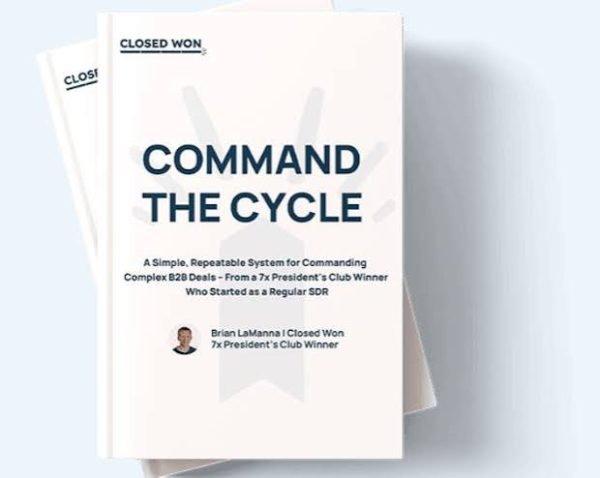

Brian LaManna – Command The Cycle
A practical B2B sales playbook for managing deals from the first conversation to the final signature.
A sales opportunity rarely falls apart because of one dramatic mistake. Sometimes the follow-up arrives too late. Sometimes the person who supports your solution cannot influence the final decision. A promising demo ends without a clear next step, or procurement gets involved when nobody has prepared for the questions that come with it. Before long, a deal that looked healthy is sitting in the pipeline with no obvious path forward.
These everyday problems are the territory of Brian LaManna – Command The Cycle.
Rather than concentrating on a single skill, this sales training resource takes a broader look at how B2B professionals manage opportunities throughout the deal lifecycle. Its focus extends beyond the conversations themselves to the preparation, coordination, communication, and planning that happen between meetings.
Brian LaManna introduced the playbook as a practical guide covering the details that salespeople often have to learn through experience. His published announcement describes a 94-page resource addressing call preparation, point-of-view development, follow-up, stakeholder relationships, procurement, negotiation, executive alignment, and AI-assisted workflows. Read Brian LaManna’s announcement.
The idea behind Command The Cycle is straightforward: sales execution becomes easier to manage when there is a repeatable process for deciding what should happen next.
For account executives, SaaS sales professionals, and other B2B sellers who work on multi-step deals, this resource offers a framework for bringing more structure to the entire process—not just the first call or the closing conversation.
The Deal Is More Than the Meeting
Consider a familiar situation. You have a productive conversation with a potential customer. They understand the solution, agree that the problem matters, and seem interested in moving forward. You send a follow-up email, schedule a demo, and update your CRM.
Then the opportunity slows down.
A stakeholder who was not present raises a new objection. The buyer asks for pricing before the value has been fully discussed. A technical review introduces another requirement. Your original contact stops responding because they are trying to get internal approval.
At this point, simply becoming more persuasive may not solve the problem. You need to understand the buying process, identify the people involved, and create a sensible path through the remaining decisions.
That is where Command The Cycle’s full-lifecycle perspective becomes relevant.
The material looks at the work surrounding each stage of a deal: preparing before a meeting, recording what was learned, deciding on the next action, keeping relevant people engaged, handling commercial discussions, and coordinating the final steps.
This perspective can be especially useful for sales professionals who already know how to hold a conversation but want a clearer method for managing everything that happens afterward.
What You’ll Learn From Command The Cycle
1. Prepare With a Purpose Before Every Call
A meeting is easier to lead when you know why it is happening and what you want to understand by the end.
The playbook addresses pre-call preparation, including a 15-minute preparation framework, deal-related research, next-step planning, and the development of a point of view. These practices encourage sellers to arrive with a defined objective rather than relying entirely on improvisation.
Preparation does not need to become a lengthy research project. It should help you identify what you already know, what still needs to be confirmed, and which questions are most relevant to the current stage of the opportunity.
For example, before an upcoming meeting, you might review previous conversations, note the prospect’s stated priorities, identify any unanswered questions, and decide what a useful next step would look like.
This makes it easier to keep the discussion focused without turning it into a rigid script.
2. Give Every Conversation a Clear Next Step
One of the practical challenges in B2B sales is ending a meeting with a positive feeling but no concrete agreement about what happens next.
A prospect may say that the discussion was helpful and that they will get back to you. Both sides leave on good terms, yet neither has committed to a specific action.
Command The Cycle highlights next-step planning through its NSTW, or “Next Step to Win,” framework. The concept is to connect each conversation to an appropriate action that advances the opportunity.
Depending on the deal, that might mean arranging a technical review, introducing another stakeholder, reviewing a business case, or agreeing on the information needed for a decision.
A next step should be relevant to the buyer, not simply another meeting added to the calendar. When both sides understand its purpose, it becomes easier to assess progress and identify what remains unresolved.
3. Improve Discovery and Early-Stage Follow-Up
The first few conversations establish the context for everything that follows. If important details are misunderstood or left unexplored, those gaps can become more difficult to resolve later.
The training addresses first-call scripting, post-call follow-up, and a “What We Learned” framework. Together, these topics focus on maintaining continuity between discovery and subsequent sales activities.
A useful follow-up should do more than thank someone for their time. It can summarize the business problem discussed, confirm the priorities that matter, identify outstanding questions, and explain the agreed next step.
The “What We Learned” approach can also help bridge a discovery conversation and a product demonstration. Rather than launching into a demo based on assumptions, the seller can use the information gathered to establish which areas deserve attention.
The result is a more connected buying experience, with fewer unnecessary repetitions and a clearer reason for each subsequent interaction.
4. Build Relationships Beyond a Single Contact
In complex B2B sales, one enthusiastic contact is not always enough to get a purchase approved.
The user evaluating a solution may care about usability. A department leader may be concerned with productivity. Finance may need a clear commercial justification, while security or IT teams may have their own review requirements.
Command The Cycle includes multithreading and stakeholder-mapping strategies designed for these situations. The aim is to understand the broader buying group rather than depending entirely on one relationship.
That does not mean contacting everyone in an organization indiscriminately. It means identifying the people whose perspectives are relevant and finding appropriate ways to involve them.
For example, a seller might ask their primary contact how the team normally evaluates a purchase, who needs to approve implementation, and whether another department should review the proposed approach.
A wider understanding of the buying group can help sellers prepare for different priorities, spot missing relationships, and avoid assuming that one person’s enthusiasm represents a final organizational decision.
5. Make Demonstrations More Relevant
A product demo can consume a lot of time without answering the buyer’s most important questions.
When a seller focuses on every available feature, the prospect may struggle to connect the presentation to the business problem that prompted the conversation. A more focused demonstration begins with what the team needs to understand or evaluate.
The playbook’s demo and presentation material covers digital sales rooms, group-demo techniques, stakeholder engagement, and value-focused touchpoints between meetings.
These topics encourage a more deliberate approach to showing the solution and maintaining interest after the presentation ends.
For instance, a seller might organize supporting information in a shared digital space, confirm the specific outcomes the buyer wants to see during a demo, and follow up with resources that address the questions raised.
The aim is not to make every presentation elaborate. It is to make the demonstration useful to the people involved in the decision.
6. Maintain Momentum Between Meetings
Much of the work in a sales cycle happens when nobody is on a call.
A buyer may need to discuss the proposal internally. A stakeholder may have a question that does not require another formal meeting. A project can lose priority while other business demands take attention away from the purchase.
Command The Cycle addresses value touches, follow-up communication, email responsiveness, and internal deal coordination. The emphasis is on keeping communication relevant and making progress easier to understand.
A useful touchpoint contributes something: an answer to an open question, a resource connected to the prospect’s goals, a summary of an agreed action, or information that helps the buyer move forward.
This is different from repeatedly asking whether someone has made a decision.
Consistent communication can help keep an opportunity organized, but the timing and frequency should still respect the prospect’s preferences. More messages do not automatically mean more momentum.
7. Coordinate Your Internal Team
A complex deal often involves more than the salesperson and the customer. Technical specialists, implementation teams, managers, legal teams, and other colleagues may need to contribute before an agreement can be completed.
The playbook includes internal deal orchestration, including a Slack deal-room strategy, to help sellers coordinate relevant information and responsibilities.
The practical challenge is keeping everyone aligned on the current status, the main risks, the buyer’s priorities, and the actions still required.
Without that coordination, teams may duplicate work, miss important details, or discover late in the process that a commitment cannot be delivered as expected.
A structured internal process can make responsibilities clearer and help sales professionals bring the right colleagues into a deal at the appropriate time.
8. Approach Pricing and Negotiation With Structure
Pricing conversations can change the tone of a deal quickly. If a buyer raises the budget before the business value is understood, a seller may feel pressured to defend a number without knowing the real concern behind the question.
Command The Cycle includes material on pricing calls, handling early pricing questions, collaborative negotiation, and mutual success planning.
The goal is to prepare sellers for commercial discussions rather than treating negotiation as a last-minute test of confidence.
A buyer’s question about price could reflect budget limitations, uncertainty about the expected value, a comparison with another vendor, or an internal approval requirement. Understanding the reason behind the question helps determine which response is appropriate.
The Working Together framework is positioned around a more collaborative approach to negotiation. Instead of assuming that every discussion is a contest, sellers can explore what both parties need for a workable agreement.
Mutual success planning also helps make the remaining steps visible, including the responsibilities and milestones needed to reach a decision.
No framework can guarantee a favorable negotiation, but preparation can make the process more organized and less reactive.
9. Navigate Legal, Security, and Procurement Reviews
A buyer can be ready to proceed commercially while the organization still needs to complete legal, security, procurement, or implementation reviews.
These stages can be difficult to manage when they are treated as administrative details that can be sorted out at the end.
The late-stage material in Command The Cycle addresses professional-services momentum and the work needed to maintain progress during these reviews.
A more deliberate approach starts by understanding the organization’s approval process, identifying the relevant stakeholders, and confirming what information or documentation is required.
The seller should also avoid promising deadlines that depend on people or processes outside their control. The objective is to create visibility and coordinate next steps, not manufacture urgency or pressure a buyer into skipping necessary checks.
10. Align Executives and Strengthen the Post-Sale Relationship
Some opportunities require senior-level alignment before a final decision. Executives may need to understand the business rationale, strategic fit, or broader organizational implications of the purchase.
The playbook covers executive alignment—described in the material as “Jersey Matching”—along with champion-building and post-signature partnership.
Executive involvement is most useful when there is a genuine reason for it. A relevant conversation between senior stakeholders can help clarify strategic priorities or address an issue that cannot be resolved at the operational level.
The work does not end when a contract is signed, either. A clear handoff and a thoughtful post-sale relationship can help establish expectations, coordinate implementation, and create a foundation for future collaboration.
The emphasis is on treating the close as a transition into the customer relationship rather than the end of all responsibility.
11. Use AI to Support the Sales Workflow
AI can be useful for organizing research, drafting routine communications, summarizing meetings, and preparing for commercial conversations. Command The Cycle incorporates AI into its wider deal-management approach.
The official launch announcement specifically describes AI as a way to make activities across the cycle more efficient. Third-party product listings also describe AI prompts among the resources offered, although the precise contents of a third-party package should be confirmed before purchase.
Used carefully, an AI tool might help turn approved meeting notes into a first draft of a follow-up email or organize known information into a preparation checklist.
The seller still needs to verify the facts, remove incorrect assumptions, and ensure that the message reflects the actual conversation. Confidential customer information should only be entered into AI systems approved for that use.
The purpose is to reduce repetitive work while preserving the judgment, context, and personal communication that effective selling requires.
Who Should Consider This Playbook?
Account executives: Particularly relevant for sellers who manage opportunities from discovery through negotiation and closing, rather than handing deals off after the first meeting.
SaaS and technology sales professionals: The stakeholder, demo, procurement, and deal-management topics may be useful for selling products that require evaluation by several teams.
Enterprise sales representatives: Multi-threading, executive alignment, internal coordination, and mutual success planning can be relevant when a deal involves multiple decision-makers and longer approval processes.
Sales professionals who struggle with stalled opportunities: The stage-by-stage approach may help identify missing next steps, gaps in stakeholder relationships, and communication issues.
Sales managers and team leaders: The frameworks can serve as reference material for coaching reps and discussing how opportunities are being managed.
The playbook may be less suitable for someone who is still learning the basics of prospecting or sells simple, one-step transactions. Its strongest fit is with sellers who already have active opportunities and want a more structured way to manage them.
What Makes Command The Cycle Different?
The distinguishing idea is its attention to the work between calls. Many sellers spend time improving their presentation skills while overlooking preparation, follow-up, internal coordination, and the process required to move a buying group toward a decision.
Command The Cycle brings those activities together within a single deal-management framework.
Brian LaManna’s published launch announcement describes the original resource as a 94-page playbook. Some third-party listings describe additional resources, including scripts, video tutorials, templates, and AI prompts. Since the exact package may vary by seller or edition, verify those inclusions before publishing a specific inventory of materials on a product page.
The practical appeal is the ability to take one part of the process at a time. A seller preparing for a pricing discussion can focus on negotiation. Someone managing a stalled opportunity can review next-step planning or stakeholder engagement. A rep preparing for a demo can revisit the material relevant to that stage.
This makes the playbook a working reference rather than something that needs to be consumed in one sitting.
Potential Benefits and Realistic Expectations
With thoughtful application, the material may help sellers establish a more consistent preparation routine, communicate next steps more clearly, involve relevant stakeholders, and spot gaps before they become major obstacles.
It can also provide sales managers with a shared vocabulary for discussing deal progression and coaching reps through specific challenges.
However, training is only one part of sales performance. Results depend on the product, market conditions, lead quality, pricing, competition, customer priorities, and the seller’s ability to apply the material appropriately.
Command The Cycle should not be presented as a guarantee of higher quota attainment, a particular close rate, or increased earnings. Its value is in providing methods that sellers can evaluate and adapt to their own sales environment.
Final Take: A System for the Work That Happens Between Calls
Brian LaManna – Command The Cycle is a B2B sales playbook for professionals who want to manage the entire deal process with greater intention. Its coverage ranges from pre-call preparation and discovery to stakeholder relationships, demonstrations, negotiation, procurement, executive alignment, and post-signature partnership.
The key takeaway is that a deal should not depend on memory, improvisation, or a vague sense that the buyer is interested. Sellers need to understand the current stage, identify what remains unresolved, and agree on a meaningful next action.
For professionals managing multi-step B2B opportunities, this approach may provide a useful structure for improving day-to-day execution. Review the official creator’s materials and purchase terms to confirm the edition and included resources before buying.
Purchasing note: Start with Brian LaManna’s published announcement and verify the current offer through the creator’s sales channel. If purchasing a third-party download, check distribution authorization, the exact format, and whether any official updates or support are included. Do not assume a standalone PDF includes benefits sold separately by the creator.


Reviews
There are no reviews yet.