
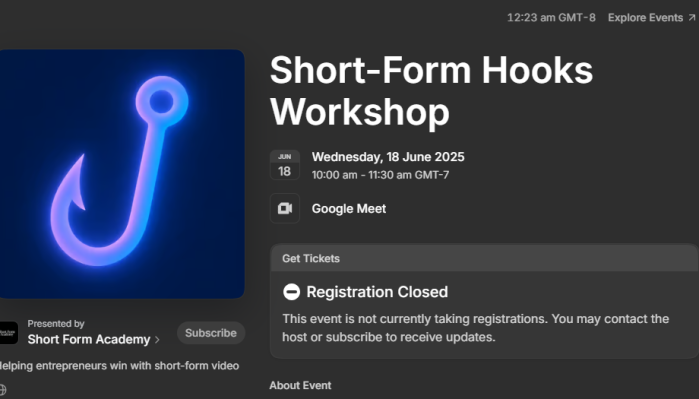

Kallaway – Short-Form Hooks Workshop: Give Your Videos a Stronger Opening
You can spend hours researching a topic, writing a script, recording footage, and editing a video. But if the opening does not give someone a reason to stay, much of that effort may never get noticed.
That is the problem Kallaway’s Short-Form Hooks Workshop is designed to address.
The workshop focuses on the first moments of a short-form video and the decisions that make an opening worth watching. Instead of relying on random catchy phrases or copying whatever is trending, it introduces a more organized way to study hooks, understand why they work, and develop new openings for your own content.
Created by Kallaway, also known as Kane Kallaway, this training brings together hook psychology, research techniques, writing frameworks, and practical examples. It is particularly relevant to creators and businesses producing content for platforms such as TikTok, Instagram Reels, and YouTube Shorts.
The central idea is simple: a strong hook should not be an afterthought. It deserves its own research and writing process.
The problem with writing hooks from scratch
Imagine you are preparing a video about improving email marketing.
You open your document and write:
“Today, I’m going to share five email marketing tips.”
It explains the subject, but it does not necessarily create much curiosity. The viewer already knows what the video is about, yet has little reason to choose it over the many other videos covering the same topic.
Now imagine approaching the same subject from a more specific angle:
“Your emails might be losing sales before anyone reaches the offer.”
This opening introduces a problem and gives the viewer a reason to find out more.
The difference is not simply about using dramatic words. It comes from understanding the audience, choosing an interesting angle, and presenting the idea in a way that makes the next few seconds feel worthwhile.
That is the kind of thinking the workshop explores.
Inside the workshop: six important areas of hook writing
1. Understand the psychology behind attention
Before writing better openings, it helps to understand why people stop scrolling in the first place.
Kallaway’s workshop explores the psychological side of hooks and the viewer’s decision to keep watching. The official description discusses psychological triggers, audience behavior, and the difference between generic viral formulas and a more deliberate approach to creating attention.
This section encourages creators to think beyond the wording of a hook.
A useful opening needs to make sense to the intended audience. It may introduce a problem they recognize, create curiosity around an unexpected idea, challenge an assumption, or suggest that the viewer is about to learn something useful.
The important question becomes:
What makes this particular viewer interested enough to give the video another few seconds?
Understanding that question can help creators make more thoughtful decisions when planning content.
2. Learn the four building blocks of a hook
The workshop introduces four hook components and explains why they need to work together.
The purpose of this framework is to give creators a way to examine an opening rather than judging it only by whether the sentence sounds interesting.
A hook can contain a strong idea but still feel confusing if the different elements do not support one another. Likewise, an opening may sound exciting but fail to connect with the actual subject of the video.
By studying the components and their alignment, creators can develop a more consistent way to evaluate their openings.
This is particularly useful when writing for different audiences. A hook for a business owner may need a different angle from one aimed at a casual entertainment audience, even when both videos cover a similar subject.
3. Research winning hooks before writing
One of the most practical parts of the training is its focus on research.
Many creators sit down with a blank page and expect original ideas to appear immediately. When that does not happen, they often repeat familiar openings or rely on generic templates.
The workshop introduces a research process for finding and validating hook ideas before creating a video.
Instead of beginning with a completely blank document, you can study examples from creators and brands, look for patterns, and understand how different openings introduce a subject.
The official course material also describes a database of more than 400 analyzed and tagged hooks. This gives learners a collection of examples to examine rather than relying entirely on memory or guesswork. <Cite refs={[“turn117027view1″,”turn117027view2”]}/>
The useful lesson here is not to copy another creator word for word. It is to understand the structure behind an effective opening and adapt the underlying idea to your own audience and subject.
4. Follow the 10-minute hook creation framework
A repeatable writing process can make content planning less frustrating.
Kallaway presents a 10-minute hook creation framework intended to help creators move from an initial topic to a more developed opening.
Rather than spending too long trying to find one perfect sentence, the approach encourages a more organized sequence of thinking.
For example, when planning a video, you might:
- Identify the main topic and the audience you want to reach.
- Decide what problem, question, or interesting idea deserves attention.
- Research relevant examples from other content.
- Explore different ways to introduce the subject.
- Compare possible openings and select the clearest direction.
- Check whether the hook connects naturally to the rest of the video.
These points illustrate the practical application of a structured hook-writing process; they are not presented as a verbatim transcript of the workshop.
The benefit of a framework is that you have a starting point whenever you need to create another video. You are not depending entirely on inspiration to arrive at the right moment.
5. Study real examples of strong and weak hooks
Frameworks become easier to understand when you can see them applied.
The workshop includes examples from creators and brands across different categories. It also describes side-by-side comparisons of hooks that performed well and hooks that did not perform as strongly.
This is valuable because an opening that looks good on paper may not work as expected when presented to an actual audience.
Consider a business making videos about its products. One opening might focus on the product’s features, while another might introduce a problem that customers already recognize.
Both approaches communicate information, but they give viewers different reasons to pay attention.
By studying examples across e-commerce, coaching, service businesses, and creator content, learners can explore how hooks need to change depending on the subject and intended audience.
6. Watch the live hook-writing demonstration
The workshop is not limited to explaining concepts.
Its official event description includes a live demonstration in which Kallaway transforms ordinary topics into more compelling video openings while explaining the thought process behind the work.
Seeing the process happen in real time can be helpful for people who understand the theory but struggle to apply it.
You can observe how a topic is examined, how possible angles are considered, and how an initial idea is developed into a more focused hook.
The original live workshop also advertised an opportunity for participants to ask questions and receive feedback on their particular niche or content challenges. Whether that interaction is available with a recording-only package should be confirmed separately. <Cite refs={[“turn117027view0”]}/>
What is included in the workshop?
The creator’s published workshop information and related announcement describe the following resources:
- Recorded workshop: Access to the training session after the live event.
- Curriculum document: Supporting written material covering the workshop’s subject matter.
- Hook research database: A collection of 400+ analyzed and tagged hook examples.
- Psychology framework: Training about why certain openings attract attention.
- Four hook components: A framework for examining the structure and alignment of video openings.
- Research method: A process for finding and evaluating hook examples.
- 10-minute writing framework: A repeatable approach to developing hooks.
- Practical examples: Breakdowns of successful and unsuccessful openings across multiple niches.
The original event page advertised recording and materials access for purchasers. The creator’s announcement specifically describes the curriculum document and 400+ hook database as part of the recording package. Check the exact contents of the version you are purchasing before making these items part of a product guarantee. <Cite refs={[“turn117027view0″,”turn117027view1”]}/>
Where can you apply these ideas?
The workshop is focused on the opening of a video, but the skill is relevant to several kinds of content.
Instagram Reels: Develop more interesting introductions for educational posts, product demonstrations, personal-brand content, and business advice.
TikTok videos: Explore different ways to present an idea so that the intended audience understands why it matters.
YouTube Shorts: Make the opening more focused and connected to the main point of the video.
E-commerce content: Introduce a product through a customer problem, use case, or interesting benefit rather than starting with a generic product description.
Coaching and consulting: Develop openings that speak to a specific challenge faced by potential clients.
Educational content: Make lessons, tutorials, and explanations easier to approach by introducing the question or problem first.
Personal branding: Build a recognizable way of presenting ideas without relying on the same opening line in every video.
The framework can be adapted to different subjects, but it still needs to be tested against the interests of the people watching.
Who should consider this training?
This workshop may be useful if you:
- Regularly create short-form videos and struggle with the first sentence.
- Manage social media content for a business or client.
- Write scripts for TikTok, Instagram Reels, or YouTube Shorts.
- Create educational videos and want more engaging introductions.
- Work in digital marketing, content strategy, or brand communication.
- Want a research-based approach instead of constantly searching for new hook templates.
- Need a more organized way to generate and compare opening ideas.
It may be less relevant to someone looking for a complete video-production course covering camera equipment, advanced editing, lighting, animation, and full social media monetization. The workshop’s main subject is hook creation, not every stage of producing and growing a content channel.
A realistic look at what this workshop can and cannot do
A better opening can improve how clearly a video communicates its subject and gives people a reason to watch. However, no hook-writing framework can guarantee viral views, followers, leads, or sales.
A video’s performance also depends on its topic, audience fit, storytelling, delivery, editing, platform distribution, and the value of the content after the opening.
A hook that performs well for one creator may not produce the same response for another. That is why research and testing matter.
It is also important to distinguish the original live workshop from other products carrying similar names. The Short-Form Hooks Workshop is a focused training session. It should not automatically be described as the full Short Form Academy membership, which is a separate offering.
Final verdict: Is the Short-Form Hooks Workshop worth exploring?
Kallaway’s Short-Form Hooks Workshop takes a narrow but important part of content creation and gives it a dedicated process.
Instead of treating hooks as quick opening lines that can be written at the last minute, the workshop explores the psychology, research, structure, and writing decisions behind them.
Its combination of practical examples, a repeatable framework, and a large collection of hook references makes the subject especially relevant to creators who publish regularly and want to improve their content-planning process.
If your biggest challenge is knowing how to begin a short-form video, this workshop offers a focused way to study that skill and put it into practice.
Frequently Asked Questions
1. What is Kallaway’s Short-Form Hooks Workshop?
It is a focused training workshop about writing effective openings for short-form videos. It covers hook psychology, research, hook components, a repeatable writing framework, and practical examples.
2. Who is Kallaway?
Kallaway is the creator name used by Kane Kallaway, a short-form content educator who shares strategies for video creation, storytelling, and social media growth.
3. What will I learn from this workshop?
You will explore the psychology behind video hooks, the four components of a hook, hook research, the 10-minute creation framework, and examples of successful and unsuccessful openings.
4. Does the workshop cover TikTok and Instagram Reels?
The hook-writing concepts are designed for short-form video and can be applied to platforms such as TikTok, Instagram Reels, and YouTube Shorts.
5. Does it include a hook database?
The creator’s published announcement describes a database containing more than 400 analyzed and tagged hooks. Confirm that the specific package you purchase includes this resource.
6. Is there a recorded version?
Yes. The official event page provides a purchase option for the workshop recording. The original announcement also describes recording access and accompanying materials for buyers.



Reviews
There are no reviews yet.