

Build a Design Studio That Works Beyond the Next Client Project
There is a point in running a creative business when being good at the work is no longer enough.
You might be a talented designer with a solid portfolio, happy clients, and a steady stream of projects. Yet the business can still feel unpredictable. Pricing decisions take too long. Every new client seems to require a different process. Marketing happens when there is a quiet week, and when projects get busy, business development gets pushed aside.
Then there is the question of capacity. How many clients can you realistically serve? When should you raise your prices? Would recurring services make your income more predictable? And if you want to grow beyond a one-person operation, what should you delegate first?
These are business questions, not design questions.
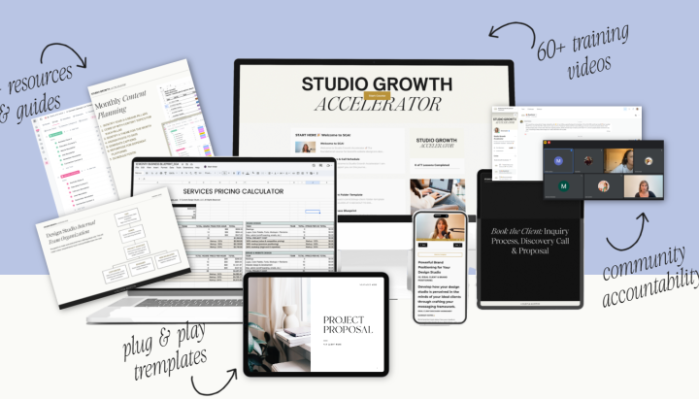
Olivia Austin – Studio Growth Accelerator is designed to address that side of running a creative studio. The program takes a broader look at how a design business is positioned, priced, marketed, organized, and delivered. Its focus is on building a studio with a clearer direction and a structure that can support growth without making the owner responsible for every little thing.
The official Studio Growth Accelerator page describes a 12-module curriculum with more than 60 videos and a library of templates, guides, and workbooks. The program is aimed at creative business owners who want to improve the way their studio operates, from the first client inquiry to long-term business development. <Cite refs={[“turn632702search1”]}/>
First, decide what kind of studio you actually want
A business can grow in a direction that looks impressive from the outside but feels completely wrong for the person running it.
More clients may mean more revenue, but they can also mean more meetings, more revisions, longer working hours, and less time for the creative work that made the business enjoyable in the first place.
The program begins with life and business vision. This is a useful starting point because it asks the studio owner to think about the kind of business they are trying to build before making decisions about marketing, pricing, or hiring.
The early training includes topics such as:
- Mapping out a life and business vision
- Identifying what is working and what needs attention
- Reviewing different areas of the business
- Clarifying priorities and the direction of future growth
- Developing practices that support consistency and focus
This kind of planning can help put business decisions into context. For example, a designer who wants a smaller number of higher-value projects may need a very different service structure from someone who wants a larger studio with multiple team members.
The goal is to make growth more intentional rather than automatically equating it with taking on more work.
Know who you want to work with
A portfolio can look beautiful and still attract the wrong inquiries.
One reason is that creative businesses sometimes communicate what they can make without making it clear who their work is best suited for. When positioning is too broad, potential clients may struggle to understand what makes the studio different.
The ideal-client and brand-positioning portion of the curriculum focuses on examining past and current clients, identifying patterns, understanding the studio’s competitive strengths, and communicating a clearer market position.
That process can be useful for answering questions such as:
- Which clients have been the best fit for the studio?
- Which projects were enjoyable and commercially worthwhile?
- What problems do those clients need help solving?
- What makes the studio’s approach different?
- Does the website communicate that difference clearly?
This is more than choosing a niche because it is popular. It is about finding the overlap between the work a studio does well, the clients it wants to serve, and the services that make business sense.
For a designer who has been accepting almost every project that comes along, this type of review can provide a more considered way to shape future inquiries.
Make the numbers behind your services work
Creative professionals often spend a great deal of time refining the quality of their work but much less time examining the financial structure behind it.
A service may be popular and still be poorly priced. A package may look attractive but require far more time than the fee justifies. And a studio can be busy throughout the month without necessarily being profitable.
Studio Growth Accelerator includes a dedicated section on structuring and pricing services. The official course information describes reviewing existing offerings, developing core packages and add-ons, and considering pricing for profitability. <Cite refs={[“turn632702search5″,”turn632702search2”]}/>
The broader questions worth working through include:
- Are your current services clearly defined?
- Which offerings are most valuable to your ideal clients?
- Are your prices appropriate for the work and time involved?
- Could a package or add-on make the buying decision easier?
- Are you spending too much time on work that does not contribute enough to the business?
This is particularly relevant to branding and web design studios, where project scope can change considerably depending on the client’s needs.
The objective is not to charge more simply for the sake of charging more. It is to create an offer structure that reflects the value and effort involved while remaining understandable to prospective clients.
Turn ambitious plans into a workable schedule
A twelve-month goal is easy to write down. Building a business plan around it takes more thought.
The strategic goal-setting module connects business targets with service offerings, client capacity, and shorter planning periods. The available curriculum descriptions mention twelve-month and quarterly planning, capacity mapping, and weekly, monthly, and quarterly tracking. <Cite refs={[“turn632702search5″,”turn632702search6”]}/>
For example, a studio owner may want to increase annual revenue. But the useful questions are more specific:
- What services will contribute to that target?
- How many projects can the studio take on?
- What is the average project value?
- How much time is needed for delivery?
- When should marketing and administrative work happen?
This kind of planning helps connect the financial target to the actual working capacity of the business.
It also makes it easier to identify when a studio is approaching its limits. If every available week is already committed to client delivery, adding more projects may not be the best next move.
Make your portfolio and website do a clearer job
A portfolio is not simply a collection of attractive projects. It is part of the studio’s sales process.
Potential clients use it to decide whether the studio’s style, experience, and approach are relevant to their needs. A website should make that decision easier, not leave visitors guessing about the services available or the next step to take.
The portfolio and website module covers what to include, what to leave out, conceptual projects, and aligning the website with the business vision.
This is useful for studios that have strong work but have not updated their presentation as their business has evolved. A designer who has moved toward larger branding projects, for instance, may need a portfolio that communicates that direction rather than continuing to feature every small project completed over the years.
The emphasis is on making the studio’s public presentation support its positioning and the kind of inquiries it wants to receive.
Improve the journey from inquiry to signed project
Getting someone interested is only one part of winning a client.
There is still the inquiry, the discovery conversation, the proposal, and the decision to move forward. If these stages are inconsistent, the experience can feel confusing for both the client and the studio owner.
The course includes a dedicated module on the inquiry process, discovery calls, and proposals. It also addresses the creative delivery process, including onboarding, boundaries, feedback, revisions, and project workflows. <Cite refs={[“turn632702search1″,”turn632702search5”]}/>
This part of the training is particularly relevant to service providers who want to make their client process feel more professional and repeatable.
A clearer process can help a studio:
- Set expectations before a project begins
- Understand the client’s needs during discovery
- Present services and proposals more clearly
- Establish boundaries around project scope
- Collect useful feedback during delivery
- Reduce unnecessary back-and-forth
The course materials also describe a one-concept approach to creative work. The intention is to create a more focused design process and manage revisions more effectively. It should be viewed as a process to evaluate and adapt to the studio’s own services, not as a guarantee that clients will never request changes.
Create a client experience people remember
The work itself matters, but so does everything surrounding it.
Clients notice how quickly questions are answered, whether the next steps are clear, how organized the project feels, and whether the studio makes the process easy to understand. Those details can influence how people remember the experience and whether they are comfortable recommending the business.
The luxury client experience module explores higher-touch communication and ways to make the service feel more considered. The available course descriptions mention client communication, a video portal, and thoughtful client touch points. <Cite refs={[“turn632702search2″,”turn632702search5”]}/>
For a small studio, improving client experience does not necessarily mean adding expensive extras. Often, it begins with consistency: a clear onboarding process, useful project updates, organized handoffs, and a professional way to present work.
The larger lesson is that the client experience should be designed just as intentionally as the creative deliverable.
Give existing clients a reason to keep working with you
A studio that relies entirely on one-off projects may find itself repeatedly starting from zero.
Once a project is finished, the owner has to find the next opportunity, bring in a new client, and repeat the sales process. That can make revenue less predictable, particularly when demand changes from month to month.
Studio Growth Accelerator includes a section on recurring revenue and ongoing design support. The published curriculum describes developing monthly recurring revenue packages, choosing pricing structures, and presenting continuing services to existing clients. <Cite refs={[“turn632702search1″,”turn632702search2”]}/>
Depending on the studio’s specialty, ongoing work might involve design support, website updates, brand maintenance, or other services that clients genuinely need after the initial project.
The important part is creating an offer with a clear purpose. A retainer should not be an arbitrary monthly fee. It should define what the client receives, how much support is included, and what falls outside the agreement.
For creative businesses, this can be a useful way to explore longer-term client relationships rather than treating every completed project as the end of the relationship.
Build a marketing routine you can maintain
Marketing often becomes inconsistent when the studio gets busy.
A designer may post regularly for a few weeks, stop when client work increases, and then return to marketing when the project calendar becomes quiet. The result is a cycle in which business development competes with delivery work.
The marketing module covers several channels relevant to design studios, including social media, email marketing, Pinterest, networking, and collaborations. The course descriptions also refer to content planning and building visibility through professional connections. <Cite refs={[“turn632702search2″,”turn632702search3”]}/>
Different channels serve different purposes:
- Social media: Show the studio’s perspective, process, and selected work.
- Email marketing: Maintain contact with people who have already expressed interest.
- Pinterest: Give visual work another route to discovery over time.
- Networking: Build relationships with potential clients and complementary service providers.
- Collaborations: Connect with professionals whose audiences or services overlap with the studio’s market.
The useful takeaway is not that every studio must be active on every platform. It is that marketing should be selected and organized around the business’s audience, strengths, and available capacity.
Know when it is time to bring in help
At some point, the owner may become the bottleneck.
Client communication, project delivery, administration, marketing, and business planning can all compete for the same hours. Hiring may help, but only when the studio has a clear idea of what needs to be delegated and what kind of support is appropriate.
The hiring and internal structure module addresses team roles, job descriptions, hiring, delegation, and studio organization. Available descriptions also mention the distinction between contractors and employees, along with team management and workflow tools. <Cite refs={[“turn632702search3″,”turn632702search6”]}/>
This section can help a studio owner think through questions such as:
- Which tasks require the owner’s direct involvement?
- What work could be delegated?
- What should a new role be responsible for?
- Is there enough consistent work to justify hiring?
- What processes need to be documented first?
Hiring is not automatically the next step for every business. Sometimes the better decision is to simplify services, improve project management, or adjust pricing before adding another person to the operation.
The owner is part of the business system, too
The final part of the curriculum addresses productivity and mindset. It includes topics such as managing a schedule, developing productive habits, dealing with imposter syndrome, and using reflection tools.
This is relevant because studio growth is not just an operational challenge. Owners also need to make decisions, handle uncertainty, communicate confidently, and protect time for work that moves the business forward.
The goal is to develop a way of working that supports the studio’s direction rather than allowing every urgent task to dictate the day.
Who is this program for?
Studio Growth Accelerator is most relevant to:
- Brand and graphic designers who want to refine their positioning, packages, and client process.
- Web designers and Showit designers who want to improve how they present, sell, and deliver projects.
- Freelancers moving toward a studio model who need more structure around pricing, planning, and operations.
- Established creative studio owners who want to explore recurring services, marketing systems, or team growth.
- Creative entrepreneurs who want to approach their business as a structured service company rather than relying only on individual projects.
It may be less relevant to someone looking for a technical design software course, a beginner’s guide to graphic design, or a general marketing program unrelated to creative service businesses.
What to know about the available versions
The official Studio Growth Accelerator page promotes different enrollment tiers. The listed offer includes a foundational curriculum, while higher tiers describe additional community support, calls, templates, and one-to-one coaching. Those extras are tier-dependent and should not be assumed to be part of every purchase. <Cite refs={[“turn632702search1”]}/>
Third-party downloadable listings describe separate file packages and should not be treated as proof of current official membership access. Before purchasing, check the exact contents, seller authorization, delivery method, access terms, and refund policy.
Final assessment
A creative studio needs more than good design work to grow in a healthy way. It needs a clear market position, services that make financial sense, a reliable client process, consistent marketing, and operations that can support the owner’s ambitions.
That is the business side of design that Olivia Austin’s Studio Growth Accelerator sets out to address.
Its strongest appeal is the breadth of the curriculum. Instead of concentrating on one isolated skill, it connects the major parts of running a design studio—from deciding what kind of business to build to pricing services, presenting a portfolio, managing clients, developing recurring revenue, and considering a team.
For designers who already have a service business and want to make it more intentional and organized, the program offers a structured set of topics to work through. The real benefit will depend on how thoughtfully the ideas are applied to the studio’s own clients, finances, services, and capacity.



Reviews
There are no reviews yet.