

Larry Williams – Annual Forecast 2026
A year-ahead market outlook built around cycles, historical patterns, and global financial markets
Financial markets rarely move in a straight line. A strong period in stocks can be followed by a correction, commodities can develop their own trends, and currency or bond markets may behave differently from equities. For traders trying to understand the bigger picture, looking at individual price movements is only one part of the process.
That is the perspective behind Larry Williams – Annual Forecast 2026.
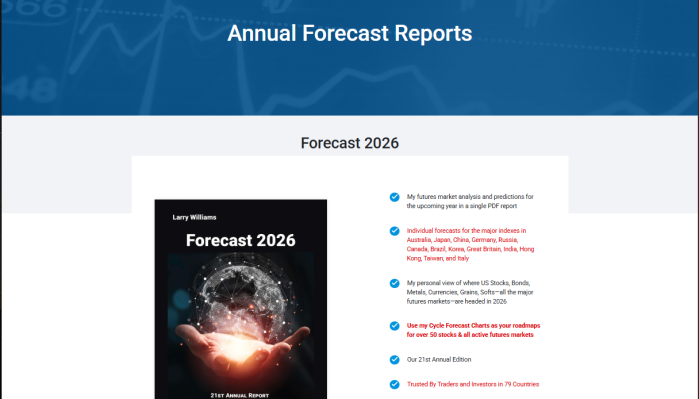
Rather than focusing on a single stock, trading setup, or asset class, this annual report takes a wider view of the financial markets. It brings together Larry Williams’ market analysis and forecasts for the year, covering US and international stock indexes, bonds, metals, currencies, grains, soft commodities, and futures markets.
The report’s distinctive feature is its use of market-cycle analysis. Historical price behavior and cycle forecast charts are presented as tools for examining when markets may become more favorable or encounter periods of weakness.
For traders who follow technical analysis, seasonal patterns, and longer-term market trends, the report offers a broad research reference for studying the 2026 trading environment.
What is included in the Annual Forecast?
The official publisher describes the 2026 edition as a single PDF report with several areas of market coverage.
Here is a closer look at the main components.
1. US stock market outlook
The US stock market is one of the major subjects of the annual forecast.
Stocks are influenced by a combination of economic conditions, investor expectations, company performance, interest rates, and market sentiment. A yearly outlook can help traders organize these different factors into a broader view rather than reacting to every daily market headline.
Larry Williams’ public 2026 market commentary discussed several considerations for the US equity market, including:
- Historical market cycles
- Stock market valuations
- Employment trends
- Yield curve behavior
- Money supply patterns
- Investor sentiment
- Potential changes in inflation
His December 2025 StockCharts presentation expressed a generally constructive outlook for US stocks during parts of 2026, while also identifying possible risks later in the year.
These comments provide context for his forecasting approach, but they should not be treated as guaranteed outcomes or a substitute for checking the actual report.
2. International stock index forecasts
Markets outside the United States are also part of the report.
The official description identifies individual forecasts for major indexes in the following countries and regions:
- Australia
- Japan
- China
- Germany
- Russia
- Canada
- Brazil
- South Korea
- Great Britain
- India
- Hong Kong
- Taiwan
- Italy
This international coverage gives the report a broader scope than a US-only market outlook.
Different countries have different economic conditions, monetary policies, market structures, and investor behavior. Looking at multiple indexes can help traders compare regional trends and identify markets that may be behaving differently from one another.
For investors who follow international equities, these forecasts provide another research perspective to consider alongside their own market analysis.
3. Bonds and interest-rate markets
Bonds are an important part of the wider financial market environment.
Interest-rate expectations can influence stock valuations, borrowing costs, currency movements, and investor demand for different asset classes. For that reason, bond market conditions are relevant even to traders whose main focus is equities.
The Annual Forecast 2026 includes Larry Williams’ view of the bond market as part of its wider financial outlook.
His public commentary for 2026 also discussed interest rates and the relationship between economic conditions and market cycles.
For readers, this section may help place stock market expectations into a broader financial context rather than treating equities as an isolated market.
4. Metals and commodity markets
Commodity markets often develop trends that are different from those seen in stocks and bonds.
Metals, agricultural markets, and soft commodities can respond to supply and demand, economic activity, seasonal influences, currency movements, and broader market conditions.
The official report description includes forecasts for:
- Metals
- Grains
- Soft commodities
- Active futures markets
This makes the report relevant to traders who follow commodities alongside traditional financial instruments.
Rather than limiting the research to a handful of popular stocks, the annual publication aims to provide a wider view of the markets Larry Williams follows.
5. Currency market forecasts
Currencies are another part of the report’s coverage.
Foreign exchange markets respond to interest-rate differences, economic expectations, monetary policy, capital flows, and global risk sentiment. These influences can create trading opportunities as well as periods of uncertainty.
The report includes Larry Williams’ personal outlook on major currency markets.
For forex traders, this can serve as an additional research reference when comparing currency trends and considering the broader direction of financial markets.
It is important to remember that a yearly forecast is not a real-time trading signal. Currency prices can change quickly when new economic information or unexpected events affect market expectations.
6. Cycle Forecast Charts for more than 50 stocks
One of the most distinctive elements of the report is its collection of cycle forecast charts.
According to the official publisher, these charts cover more than 50 stocks and all active futures markets.
Cycle analysis is based on studying recurring patterns in historical market behavior. Analysts use these patterns to examine whether certain periods have historically been associated with market strength, weakness, or potential turning points.
Larry Williams has used cycle analysis throughout his market research and trading education.
The charts are intended to provide a visual reference for studying possible future market behavior. Traders can use them as one input when comparing historical patterns with current price action and other technical or fundamental information.
For example, a trader researching an individual stock might consider:
- Whether the broader market trend is positive or negative
- Whether the stock’s historical cycle suggests a potential turning point
- How the current price structure compares with the cycle projection
- Whether other indicators support or contradict the expected pattern
The purpose is to create a broader research framework, not to treat a cycle chart as a guaranteed prediction.
Understanding the forecasting approach
A forecast is only as useful as the reasoning behind it.
Larry Williams’ public market commentary provides some insight into the factors he considers when developing his outlook.
His December 2025 presentation about the 2026 market environment discussed several areas:
Historical market cycles: Studying recurring patterns in market data to identify periods that may be more favorable or unfavorable for different assets.
Valuations: Considering stock market valuation levels and how they compare with historical conditions.
Employment data: Examining employment trends as one of the economic factors that may influence stock market performance.
Yield curve behavior: Following changes in the relationship between short-term and long-term interest rates.
Money supply: Studying changes in monetary conditions and their possible relationship with broader equity market trends.
Investor sentiment: Considering how investor expectations and market psychology may relate to market movements.
This combination of cycle analysis and economic indicators gives the annual forecast a wider research perspective.
The exact calculations, chart interpretations, and individual market projections should be checked in the original PDF rather than inferred from a public presentation.
Who should consider this report?
The Annual Forecast 2026 is aimed primarily at people who already follow financial markets and want an additional perspective on the year ahead.
Stock market traders
Traders who follow US and international equities may find the global index forecasts and individual stock cycle charts relevant to their research.
Futures traders
The report’s coverage of active futures markets, metals, grains, and soft commodities makes it relevant to people who trade or study futures contracts.
Forex traders
Readers interested in currency markets may appreciate having the currency outlook included alongside stocks, bonds, and commodities.
Technical analysts
People who use historical patterns, market cycles, and price-based research may find the cycle forecast charts particularly interesting.
Longer-term investors
Investors who prefer to study the broader market environment may use the report as one reference when evaluating their own expectations for 2026.
What makes this edition different?
The 2026 publication is identified by the official publisher as the 21st annual edition of Larry Williams’ forecast reports.
Its appeal comes from the combination of several market categories in one document.
Instead of purchasing separate research for stocks, commodities, currencies, and futures, readers get a consolidated annual outlook that covers multiple areas of the financial markets.
The inclusion of cycle charts for more than 50 stocks and active futures markets is another distinguishing feature.
It gives readers more than a general discussion of the economy. The report is designed to provide market-specific research that can be compared with individual trading strategies and independent analysis.
Important considerations before using the forecast
Annual forecasts can be useful research references, but they have limitations.
Market conditions change. Economic data can be revised, central banks can change policy, geopolitical events can affect prices, and unexpected developments can invalidate previously reasonable expectations.
A forecast should therefore be treated as a viewpoint to evaluate, not an instruction to buy or sell.
Keep the following points in mind:
- Forecasts are not guarantees. No market analyst can reliably predict every market movement.
- Use independent confirmation. Compare projections with current prices, economic information, and your own trading rules.
- Manage risk. Position sizing, stop-loss planning, and exposure limits remain important regardless of the forecast.
- Check the reporting period. This is a 2026 annual report, not a live market-data service.
- Do not assume real-time updates. The official description identifies a PDF report; it does not establish continuous updates or personal trading support.
Report format and availability
The official I Really Trade website describes Annual Forecast 2026 as a single PDF report and identifies it as the 21st annual edition.
The publisher’s page also states that the 2026 report sale has ended and directs visitors to return in December for the 2027 edition.
That makes it especially important to check the source and delivery details before purchasing a copy through another seller.
If a third-party store offers this report, customers should be told whether they are receiving an authorized PDF, what the file contains, and whether any official support or updates are included. A downloadable copy does not automatically include access to the creator’s website, trading tools, indicators, or future publications.
Final assessment
Larry Williams – Annual Forecast 2026 is a broad market research publication for traders and investors who want to study the financial markets through a combination of cycle analysis and wider economic considerations.
Its coverage extends across US stocks, international indexes, bonds, metals, currencies, grains, soft commodities, and futures markets. The cycle forecast charts for more than 50 stocks and active futures markets are a particularly notable part of the offering.
The report is most relevant to readers who already have an interest in market analysis and want another perspective to compare with their own research.
It is not a trading system that guarantees profitable entries, nor should its projections be followed without independent analysis and risk management. Its value is as a reference document for examining possible market conditions during 2026.



Reviews
There are no reviews yet.