
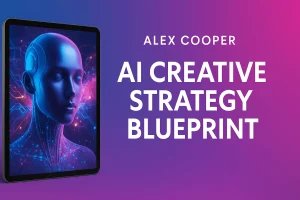

The AI Creative Strategist Blueprint: A More Systematic Way to Use AI in Advertising
There is no shortage of AI tools for marketers. You can use one platform to research an audience, another to generate images, another to write ad copy, and several more to organize campaigns or automate repetitive tasks.
But having access to all these tools does not automatically make the creative process better.
The real challenge is knowing what to ask, what information to give the AI, how to judge its output, and how to turn a promising idea into advertising that makes sense for a particular customer.
That is the problem The AI Creative Strategist Blueprint by Alex Cooper and Jimmy Slagle is designed to address.
The program brings AI technology and advertising strategy together in an eight-week training experience. Its focus is on helping marketers move beyond occasional AI experiments and develop a more structured approach to research, creative development, and workflow building.
The distinction matters. A business does not need another folder full of generic AI-generated headlines. It needs a creative process that understands its audience, reflects the product’s positioning, and gives the marketing team a practical way to produce and evaluate new ideas.
Why AI Needs a Creative Strategy Behind It
AI can produce a large amount of content very quickly. That is useful, but volume is not the same as quality.
A generated advertisement can look polished and still miss the customer’s actual concern. A headline may sound persuasive but communicate the wrong benefit. An image might attract attention without matching the product or the audience.
This is where creative strategy becomes important.
Before producing an advertisement, a marketer needs to understand the market, the product, the customer, and the reason someone might choose one offer over another. AI can support parts of this work, but the person directing the process still needs to make decisions.
The Blueprint is built around this relationship between human creative judgment and AI-assisted production. Its aim is to help learners use AI as part of a repeatable marketing system rather than as a replacement for strategic thinking.
The Eight-Week Learning Structure
The program was originally presented as an eight-week live training experience. The official provider now advertises access to recordings of the training, allowing learners to work through the material without needing to attend the original live sessions.
The broad curriculum moves from AI fundamentals into more developed workflows and advertising applications.
1. Build a Better Foundation in AI
Before connecting several tools or building complicated workflows, marketers need a working understanding of what AI can and cannot do.
The early training introduces AI foundations and the role of AI in creative work. This is relevant for marketers who have experimented with chatbots but have not yet developed a consistent process for using them.
The goal is to understand how to approach AI tasks with a clear objective, provide useful information, and evaluate the response instead of accepting the first result.
A practical example would be using AI to explore different customer motivations for a product. Rather than asking for a random list of advertising ideas, a marketer can provide product information, customer research, and a defined campaign goal to guide the exercise.
2. Prompt Engineering for More Useful Outputs
Prompt engineering is one of the foundations of AI-assisted marketing.
A prompt is not just a question. It can include context, instructions, constraints, examples, a desired format, and criteria for evaluating the response.
The Blueprint includes prompt engineering as an early part of its learning path. This is important because the quality of an AI output often depends on the quality of the information and direction provided.
For advertising, a marketer might ask an AI system to develop several creative angles for the same product. Each angle could address a different customer motivation, objection, or use case.
The marketer can then compare the ideas, reject weak suggestions, and develop the strongest concepts further.
The point is not to make AI produce more words. It is to make its contribution more relevant to the actual marketing task.
3. Context Engineering and Better Information Management
A useful creative system needs more than a well-written prompt. It also needs reliable context.
Context engineering is an important part of the program’s advertised subject matter. It concerns how information is organized and supplied to AI systems so that their outputs are more closely connected to the task.
For a brand, useful context might include product details, customer research, brand guidelines, previous campaign results, customer reviews, and examples of approved creative work.
Without that context, an AI system may produce generic suggestions that could apply to almost any business.
With a better information foundation, the marketer has a stronger starting point for developing ideas that fit the brand and its audience.
This is particularly valuable for teams that need consistency. Different people may be working on research, copy, images, and campaign production. A shared source of information can help keep their work aligned.
4. Explore Specialized AI Tools
The training’s broader approach includes using different AI platforms for different parts of the creative process.
The official program discusses tools and workflows involving ChatGPT, Claude, Google AI Studio, image-generation systems, Gumloop, and n8n, among others.
These platforms serve different purposes. Some can assist with research and writing, while others support image generation, workflow automation, or connecting multiple services.
The useful lesson is to select a tool because it fits a particular job, not simply because it is popular.
For example, a marketing team might use one system to organize customer insights, another to develop creative concepts, and a workflow platform to move approved information between tools.
The exact platforms and features available can change over time. Learners should check current pricing, usage limits, integrations, and commercial-use terms before building their own systems around them.
5. Build AI-Assisted Creative Workflows
One of the important ideas behind the Blueprint is moving from isolated prompts to connected workflows.
A workflow is a sequence of tasks that takes information from one stage to another. In a creative marketing process, that might involve research, concept development, draft production, review, and preparation for a campaign.
The program advertises workflow training involving platforms such as Gumloop and n8n.
These tools can help connect different services and reduce repetitive manual steps. They can also make a process easier to repeat across multiple projects or team members.
For example, a team could develop a workflow that organizes product information, prepares a structured creative brief, and passes approved information into the next stage of production.
Automation does not remove the need for review. Human approval remains important, especially when an advertisement makes claims about a product, its performance, or customer outcomes.
6. Develop Persona-Based Advertising
Creative strategy becomes more useful when it reflects the people an advertisement is intended to reach.
The program’s advertised applied creative strategy work includes persona-based advertising. This means thinking about different customer groups and how their motivations may influence the way they respond to a message.
Two people can buy the same product for different reasons. One may care about convenience, another about price, and someone else may be interested in a particular feature.
A single generic advertisement may not communicate equally well to all of them.
AI can help explore different angles and variations, but the strategist still needs to check whether the audience assumptions are accurate and whether the message is appropriate.
This part of the training is especially relevant to performance marketers and DTC brands that regularly test new creative concepts.
7. Bring the Creative Process Together
The later part of the program is intended to connect the earlier lessons into a broader AI-assisted creative strategy.
This is where the value of a structured approach becomes clearer. Research, prompts, context, specialized tools, and automation are more useful when they work together.
A team might begin with a customer problem, research the audience, identify a few possible advertising angles, develop concepts, and use AI tools to support production.
The strategist then reviews the output, checks the message against the brand and product, and decides which ideas are worth testing.
This is not a fully automated advertising machine. It is a process in which AI helps with selected tasks while people remain responsible for strategy, judgment, and final approval.
8. Apply the Learning to Real Marketing Work
The practical value of the program depends on whether learners apply the ideas to real products, campaigns, and creative challenges.
The official provider advertises hands-on exercises and a collection of ad creative resources alongside the eight-week training. These materials are intended to help learners move from watching demonstrations to experimenting with their own workflows.
A useful way to apply the concepts is to choose one product and build a small creative project around it.
Start with the audience and product information. Develop several possible angles. Use AI to explore variations, then review the concepts for relevance, clarity, and accuracy. Finally, prepare a few suitable creative assets for testing.
This kind of exercise can help reveal where AI saves time and where human creative judgment remains essential.
What Makes This Different from a Basic AI Marketing Course?
Many introductory AI courses focus on individual tools or simple prompt examples. Those can be useful starting points, but they may not explain how the different activities fit into an actual advertising operation.
The AI Creative Strategist Blueprint takes a broader view.
Its advertised focus includes:
- AI foundations and prompt engineering.
- Context engineering and structured information.
- Specialized AI platforms for creative work.
- Connected workflows using automation tools.
- AI-assisted creative strategy.
- Persona-based advertising concepts.
- Practical exercises and advertising resources.
This combination makes the program more relevant to people who already work in marketing or want to develop skills that connect AI with commercial creative production.
It is not a replacement for learning the fundamentals of advertising. Understanding customers, positioning, offers, messaging, and campaign measurement remains important.
Who Should Consider This Program?
Performance marketers: People working with paid social or digital advertising may find the AI-assisted creative workflow approach relevant to their day-to-day work.
DTC brand owners: Businesses that regularly need fresh advertising concepts may be interested in learning how to organize research and creative production with AI.
Creative strategists: Professionals responsible for developing advertising angles and campaign concepts can explore how AI may support their research and ideation process.
Marketing agency owners: Agencies looking to develop repeatable internal workflows may find the combination of creative strategy and automation particularly relevant.
Freelancers and consultants: Independent marketers may want to add AI-assisted research, creative development, and workflow services to their existing skill set.
Marketing teams: Teams that want to establish more consistent ways of using AI across research and production may find the program’s systems-oriented approach useful.
What to Keep in Mind Before Buying
AI platforms are changing quickly. A demonstration recorded during the original training may use an interface, feature, or pricing model that has since changed.
It is worth considering the following before purchasing:
Software costs: Some AI platforms have paid subscriptions, usage limits, or credit-based pricing. Course access does not automatically mean that all software is included.
Practical implementation: Watching a workflow demonstration is different from building and maintaining it. Allow time to test and adapt the processes.
Human review: AI-generated advertisements need careful review for factual accuracy, brand fit, copyright concerns, and platform advertising policies.
Campaign performance: A creative framework can help organize experimentation, but no training program can guarantee better ad performance, lower acquisition costs, or higher revenue.
Access and support: Confirm whether the offer includes recordings only or also includes community participation, live calls, updates, exercises, and other resources.
Final Thoughts
The AI Creative Strategist Blueprint by Alex Cooper and Jimmy Slagle is aimed at marketers who want to use artificial intelligence as part of a more organized advertising process.
Its eight-week structure covers the foundations of AI, prompting, context engineering, specialized tools, workflow automation, and persona-based creative strategy. That makes it broader than a course focused only on writing prompts or generating individual advertisements.
The most useful takeaway is the idea of connecting the different stages of creative work. Research should inform strategy, strategy should guide production, and AI-generated material should be reviewed before it becomes part of a real campaign.
For marketers, agencies, and DTC businesses that want to explore this approach, the program offers a structured subject to investigate. Its value will ultimately depend on how well learners adapt the methods to their own products, teams, and advertising goals.
Frequently Asked Questions
1. What is The AI Creative Strategist Blueprint?
It is an eight-week AI marketing and creative strategy training program created by Alex Cooper and Jimmy Slagle. It focuses on using AI for advertising research, creative development, and workflow automation.
2. Who created the AI Creative Strategist Blueprint?
The program was created by Alex Cooper and Jimmy Slagle, associated with AdCrate and Human².
3. What does the course teach?
The advertised subject areas include AI foundations, prompt engineering, context engineering, AI-assisted creative strategy, persona-based advertising, and connected workflows using tools such as Gumloop and n8n.
4. Is this an AI advertising course?
Yes. Its central focus is applying AI to advertising and creative production rather than teaching only general-purpose AI tools.
5. Does the program cover prompt engineering?
Yes. Prompt engineering is one of the foundational subjects, alongside context engineering and practical AI workflows.
6. Does it teach automation without coding?
The program includes workflow training involving platforms such as Gumloop and n8n. The specific technical requirements depend on the workflow and tools being used.


Reviews
There are no reviews yet.