
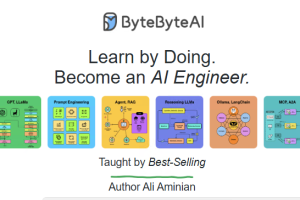

ByteByteAI – Learn by Doing: Become an AI Engineer
Go Beyond AI Theory and Start Building Real Projects
Understanding artificial intelligence is one thing. Knowing how to turn that understanding into a working application is another.
You might already know what large language models are, have experimented with AI chatbots, or use generative AI tools in your everyday work. But when it comes to building a more complete system—one that retrieves information, calls tools, evaluates its responses, or combines several AI capabilities—the technical picture can become much more complicated.
Learn by Doing: Become an AI Engineer by ByteByteAI is a project-based AI engineering course designed to help learners develop a stronger understanding of modern AI systems through practical implementation.
The official course is taught by Ali Aminian, a machine learning and generative AI author with experience at technology companies and contributions to AI education. The program follows a structured, cohort-based format that combines technical instruction, live sessions, practical projects, and opportunities for feedback.
Rather than focusing exclusively on using existing AI tools, the curriculum explores how AI applications are designed and developed. Its subjects include large language models, model training concepts, prompt engineering, retrieval-augmented generation (RAG), AI agents, evaluation, reasoning systems, and multimodal generation.
The goal is to help learners connect individual concepts and understand how they fit into complete applications.
For developers, aspiring AI engineers, and technically curious learners, this kind of project-based approach can provide a more structured way to explore the engineering challenges behind modern AI.
What Is ByteByteAI’s Become an AI Engineer Course?
Become an AI Engineer is a six-week, cohort-based program presented by ByteByteAI and taught by Ali Aminian. The official website emphasizes practical learning, structured explanations, project development, and opportunities to interact with the instructor and other learners.
The curriculum is organized around projects rather than a collection of disconnected technical topics. Each project introduces a different part of the AI engineering landscape, helping learners explore the design choices involved in building AI-powered applications.
The advertised projects include:
- Building an LLM playground.
- Creating a customer-support chatbot using RAG and prompt engineering.
- Developing an Ask-the-Web agent with tool calling.
- Exploring deep research capabilities with web search and reasoning models.
- Building a multimodal generation agent.
- Completing a capstone AI project.
These projects span several areas of modern AI development, from understanding how language models generate text to designing systems that retrieve information, use tools, and combine different types of media.
Because this is a cohort-based course, the learning experience is different from simply purchasing a static collection of videos. The official program advertises live and interactive sessions, a peer community, project feedback, recorded sessions, and a certificate of completion. Check the current enrollment page to confirm which features are included in the cohort available to you.
Explore the Project-Based Curriculum
Project 1: Build an LLM Playground
Large language models power many of today’s conversational assistants and generative AI applications. To build reliable applications around them, it helps to understand more than how to send a prompt to an API.
The first project explores LLM foundations, including pre-training, post-training, text generation, and evaluation.
The advertised curriculum covers concepts such as data collection, data cleaning, tokenization, neural network architectures, Transformers, and the GPT family of models. It also introduces post-training approaches, including supervised fine-tuning and reinforcement learning methods associated with human feedback or verifiable tasks.
These subjects help explain how models learn patterns from data and how their behavior can be refined for particular tasks.
Text generation is another important area. Techniques such as greedy decoding, beam search, top-k sampling, and top-p sampling influence how a model selects its next output tokens. Understanding these methods provides useful context for exploring the behavior of language models.
The project also introduces evaluation, including traditional metrics, task-specific benchmarks, and human evaluation.
For aspiring AI engineers, these foundations can help bridge the gap between using an existing model and understanding the systems and decisions behind it.
Project 2: Build a Customer-Support Chatbot With RAG
A general-purpose language model may not know the private information or current documents needed to answer questions about a specific business. Retrieval-augmented generation provides one approach to addressing that problem.
RAG systems retrieve relevant information from a knowledge source and provide it to a language model as context for generating an answer.
For example, a customer-support chatbot might retrieve information from product manuals, help articles, or company policies before responding to a customer question. The quality of the final answer depends partly on whether the right information was found and supplied to the model.
ByteByteAI’s advertised second project explores a customer-support chatbot built with RAG and prompt engineering. The curriculum includes document parsing, chunking strategies, indexing, embedding models, vector-based retrieval, search methods, generation, and evaluation. It also covers fine-tuning concepts such as parameter-efficient fine-tuning and LoRA.
The project addresses a central challenge in AI application development: connecting a model to relevant information without assuming that the model already knows the answer.
Evaluation is particularly important. A useful system needs more than fluent responses. It should retrieve relevant information, remain faithful to its sources, and answer the user’s question correctly.
Studying these components can help learners understand the design choices involved in developing knowledge-based AI applications.
Project 3: Build an Ask-the-Web Agent
AI agents extend beyond simple question-and-answer interactions by combining a language model with tools, workflows, and decisions about what to do next.
An Ask-the-Web application, for example, might interpret a question, search online sources, gather relevant information, and organize the findings into a response.
The third project explores agent concepts, including workflows, tool calling, multi-step agents, planning, orchestration, and evaluation. The official outline also references the Model Context Protocol (MCP), multi-agent systems, and approaches such as ReAct and Reflexion.
These topics are useful for understanding how an AI system can move through a sequence of tasks rather than generating a single response from one prompt.
A tool-using agent might first determine what information it needs, call a search tool, inspect the results, and then decide whether additional information is necessary. A more complex workflow might coordinate several specialized components.
However, agent systems also introduce challenges. Tools can fail, retrieved information can be incomplete, and a system may make an incorrect decision about its next action. Evaluation and appropriate safeguards remain important parts of the design.
This project provides a route into the engineering concepts behind applications that use language models to interact with external tools and information.
Project 4: Build Deep Research Capabilities
Some questions require more than a quick response. They may involve searching multiple sources, comparing information, following several lines of reasoning, and assembling findings into a coherent answer.
The fourth project explores research-oriented AI systems that combine web search with reasoning models.
The advertised curriculum covers reasoning and thinking models, inference-time techniques, training-time techniques, self-refinement, and methods for improving how systems approach complex tasks.
Inference-time methods can influence how a model explores possible answers or works through a problem. Training-time methods, by contrast, involve techniques used to shape a model’s behavior during training or refinement.
These distinctions matter because not every AI limitation can be addressed in the same way. Some problems call for better retrieval, others for a different model, more effective evaluation, or a workflow that breaks a complex task into smaller steps.
For developers building research assistants and information-analysis applications, this project introduces concepts that can help them reason about the architecture of more advanced systems.
The practical objective is not to assume that a reasoning model is always correct, but to understand how different components can work together and how their outputs should be assessed.
Project 5: Build a Multimodal Generation Agent
Generative AI is not limited to text. Modern systems can also work with images, video, and other forms of media.
The fifth project explores multimodal generation, including text-to-image and text-to-video concepts. The official curriculum references variational autoencoders, generative adversarial networks, autoregressive models, diffusion models, and related techniques.
The project outline also covers data preparation, diffusion architectures, sampling, evaluation, video latent representations, and the challenges involved in building video-generation systems.
These subjects help explain why image and video generation involve different technical considerations from text generation. Models must represent visual information and learn patterns that support the creation of coherent outputs.
Evaluation is also different. Depending on the application, developers may need to consider image quality, diversity, text-image alignment, and consistency across generated frames.
This project offers a route into the technical foundations of multimodal AI and the engineering decisions involved in combining generation capabilities with agent-like workflows.
Project 6: Complete a Capstone AI Project
A capstone project provides an opportunity to bring different concepts together in a single application.
According to the official course outline, learners can choose their own project idea or select from a curated list, implement it using techniques covered in the course, and iterate with instructor feedback. An optional final demo provides an opportunity to present the project.
This stage matters because a collection of completed lessons is not the same as a working project.
Developing an application requires decisions about its purpose, architecture, data sources, model selection, user experience, and evaluation. It may also involve troubleshooting errors and simplifying the design when an approach proves too complicated.
A well-scoped capstone can become a useful learning artifact and a starting point for a portfolio. Its value will depend on the quality of the implementation and how clearly the learner can explain the design decisions, limitations, and results.
The course does not guarantee employment or a particular career outcome, but completing a meaningful project can give learners something concrete to discuss when demonstrating their skills.
What Makes a Project-Based AI Course Useful?
AI engineering covers a wide range of topics, and learning them in isolation can make it difficult to understand how they connect.
For example, a developer might understand prompt engineering but have little experience evaluating a RAG system. Another learner might know how to call an LLM API but be unfamiliar with tool orchestration or multimodal generation.
A project-based learning path can help connect these concepts by placing them within practical application scenarios.
The ByteByteAI curriculum progresses through several distinct types of systems: an LLM playground, a knowledge-based chatbot, a tool-using agent, a research-oriented system, a multimodal generation application, and a capstone project.
This progression gives learners multiple examples of how AI capabilities can be assembled into applications.
The program also advertises intuitive explanations, a structured learning path, beginner-friendly code, and live interaction. These features may be helpful for learners who prefer guided instruction and the opportunity to ask questions rather than studying entirely on their own.
The key is to use the projects as a starting point for deeper understanding. Reproducing a working example is useful, but being able to explain why it works—and when it might fail—is a more meaningful engineering skill.
Who Is Become an AI Engineer For?
Software developers: Developers who want to expand from conventional application development into LLM-powered systems may find the curriculum relevant.
Aspiring AI engineers: Learners seeking a structured introduction to modern AI application development can explore the projects as a guided learning path.
Machine learning enthusiasts: People familiar with some machine learning concepts may appreciate the opportunity to study how models, retrieval, evaluation, and tools fit into complete systems.
Technical founders: Founders building AI-powered products may find the curriculum useful for understanding common application architectures and technical trade-offs.
Backend and full-stack engineers: Developers interested in integrating language models, retrieval systems, and external tools into software products may benefit from the subject matter.
Professionals changing their technical focus: People exploring AI engineering can use the course to develop practical experience, while recognizing that a career transition also requires broader technical preparation and demonstrable skills.
The official FAQ states that basic computer science knowledge and Python are required to complete the projects, although the lectures and live coding sessions are intended to be followable without those prerequisites. The stated time commitment is approximately four to six hours per week, with additional time potentially needed by learners who are new to AI or Python.
What You Can Work Toward Learning
By following the curriculum and completing the projects, learners can work toward developing skills in:
- Understanding the foundations of large language models.
- Exploring pre-training, post-training, and text-generation concepts.
- Using prompt engineering techniques appropriately.
- Designing RAG pipelines for document-based applications.
- Understanding embeddings, indexing, retrieval, and chunking.
- Evaluating AI outputs for relevance, faithfulness, and correctness.
- Building applications that use tools and multi-step workflows.
- Exploring agent orchestration and MCP.
- Understanding reasoning-oriented AI systems.
- Learning the fundamentals of multimodal generation.
- Developing and explaining a capstone AI application.
These are learning objectives based on the advertised curriculum. They are not a guarantee of mastery, employment, certification recognition by a particular employer, or professional readiness after six weeks.
Before You Enroll
ByteByteAI presents this program as a live, cohort-based course. Cohort dates, availability, pricing, and registration terms can change. The current website may show a waitlist rather than immediate enrollment, so check the official course page before publishing time-sensitive information.
The official page advertises recorded sessions, a peer community, a completion certificate, and a seven-day refund policy measured from the first live session. It also advertises ByteByteGo digital books and additional machine learning resources as bonuses. Confirm the current package and exact conditions directly with the provider before relying on any of these details.
As with any technical course, the best results generally come from writing code, debugging your own implementations, and understanding the limitations of the systems you build. The curriculum can provide structure, but it cannot replace sustained practice.
Final Overview
Learn by Doing: Become an AI Engineer by ByteByteAI is a project-oriented program for learners who want to explore how modern AI applications are built.
Its curriculum spans LLM foundations, RAG chatbots, tool-using agents, research-oriented systems, multimodal generation, and a final capstone project. The advertised live sessions and instructor feedback offer an additional layer of guidance for learners who prefer a cohort-based experience.
The course may be particularly relevant to developers and technically curious learners who want to move beyond experimenting with AI tools and begin understanding the architecture behind AI-powered applications.
Before deciding whether it is right for you, review the current curriculum, prerequisites, schedule, access terms, and refund conditions on the official website.
Official course: ByteByteAI – Become an AI Engineer.
Frequently Asked Questions
1. What is ByteByteAI – Become an AI Engineer?
It is a project-based AI engineering course designed to introduce learners to modern AI application development through guided projects, technical lessons, and a cohort-based learning experience.
2. Who teaches the course?
The official course page identifies Ali Aminian as the instructor. It describes his background in machine learning, generative AI, technical authorship, and AI education.
3. How long is the program?
The official website describes it as a six-week cohort-based course. Check the current enrollment page for the next cohort’s schedule and availability.
4. What projects are included in the curriculum?
The advertised curriculum includes an LLM playground, a RAG-based customer-support chatbot, an Ask-the-Web agent, a deep-research system, a multimodal generation agent, and a capstone project.
5. Does the course cover RAG and AI agents?
Yes. The advertised curriculum includes retrieval-augmented generation, document retrieval, prompt engineering, tool calling, agent workflows, orchestration, and evaluation.
6. Do I need Python experience?
The official FAQ says basic computer science knowledge and Python are required to complete the projects, although learners can follow the lectures and live coding sessions without those prerequisites. Beginners may need additional practice time.
7. How much time should I plan to spend studying?
The official course page estimates approximately four to six hours per week. Your actual time commitment may be higher if you are new to programming or want to explore the projects in greater depth.


Reviews
There are no reviews yet.