
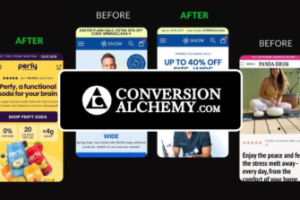

Osh – Conversion Alchemy: A Practical Approach to Shopify Conversion Optimization
Getting visitors to a Shopify store is only one part of ecommerce marketing. What happens after someone clicks an ad, opens a product page, or starts exploring an offer can be just as important. If the message is unclear, the product’s value is difficult to understand, or the shopping experience creates unnecessary friction, potential customers may leave without buying.
Osh – Conversion Alchemy is a conversion rate optimization (CRO) training program built around the process of making ecommerce websites more effective. Instead of looking at a store as a collection of individual pages, the subject is approached as a connected customer experience: the offer, messaging, page layout, product presentation, and purchase journey all influence how shoppers understand and respond to a brand.
For Shopify store owners, ecommerce marketers, freelancers, and agencies, the central idea is straightforward: before assuming that a business needs more traffic, examine whether its existing website communicates value clearly and gives visitors a compelling reason to take the next step.
The official Conversion Alchemy website describes practical frameworks for auditing stores, refining offers, improving landing pages and product detail pages, and creating a repeatable optimization process. Its Conversion Alchemy OS offer also lists implementation resources such as templates, SOPs, prompts, swipe files, and dashboards. Check the specific version being sold to confirm exactly which resources are included.
What Is Conversion Alchemy?
Conversion rate optimization is the process of improving a website or sales journey so that more of the right visitors complete a desired action. For an ecommerce business, that action might be purchasing a product, adding an item to a cart, subscribing to a list, or moving from a landing page to a product page.
Osh’s Conversion Alchemy training focuses on the practical elements that shape those decisions. These include how an offer is presented, how product benefits are explained, how page sections are organized, and how the customer experience can be evaluated and improved.
Consider a store that receives a steady stream of visitors from paid advertising but struggles to turn those visits into purchases. Increasing the advertising budget may bring in more visitors, but it does not necessarily solve the underlying problem. The product page might not explain the product’s main benefit quickly enough. Shipping information might be difficult to find. The offer might look similar to competing products, or the page may fail to address the questions customers need answered before buying.
A structured CRO process helps a store owner investigate these possibilities instead of changing random page elements without a clear reason.
What You May Learn From the Training
The precise curriculum depends on the version of Conversion Alchemy being offered. The following overview reflects the main subject areas described on the official Conversion Alchemy website, rather than a guarantee that every version contains identical lessons.
1. Understand the Numbers Behind Store Performance
Effective optimization begins with understanding what is happening on a website. A store owner needs to distinguish between a traffic problem, an offer problem, a product-page problem, and friction during checkout.
Useful metrics may include conversion rate, average order value, revenue per visitor, cart abandonment, and the performance of individual traffic sources. These numbers are most useful when considered together and in the context of the store’s margins and business model.
For example, a promotion might increase conversion rate while reducing profit per order. Another page variation might generate fewer orders but attract customers who purchase higher-value bundles. Looking at several relevant metrics helps prevent decisions based on a single number.
A structured approach to CRO can help learners ask more useful questions before deciding what to change.
2. Improve Offers and Communicate Product Value
Customers do not evaluate a product based on its features alone. They also consider whether it solves a relevant problem, how it compares with alternatives, what the price includes, and how confident they feel about buying it.
Offer optimization focuses on making that value easier to understand. Depending on the business, this could involve clarifying product benefits, presenting bundles, explaining guarantees accurately, improving product comparisons, or making the difference between product options more obvious.
Imagine a skincare store selling a cleanser and moisturizer separately. A thoughtfully presented bundle may help shoppers understand how the products work together and make it easier to choose a complete routine. Whether that bundle performs better should be measured rather than assumed.
The aim is to develop a more deliberate way to present an offer and identify where its value proposition could be clearer.
3. Write More Persuasive Ecommerce Copy
Copywriting is an important part of the online shopping experience. Headlines, product descriptions, benefit statements, calls to action, and supporting information all influence how customers understand a product.
Conversion-focused writing is not simply about using stronger sales language. It requires understanding the intended audience, identifying relevant customer concerns, and explaining the product in language that feels clear and credible.
For example, a product description that only says a backpack is made from durable materials leaves shoppers to decide why that matters. A stronger description might explain how the material is intended to handle everyday commuting, provided that claim is accurate for the product.
The goal is to connect product details with meaningful customer benefits without relying on exaggerated promises or unsupported claims.
4. Make Landing Pages Easier to Understand
A landing page needs to give visitors a clear reason to stay and continue. Its headline, main visual, offer, supporting copy, and next step should work together rather than compete for attention.
When reviewing a landing page, useful questions include:
- Can a visitor understand the offer quickly?
- Does the main headline reflect the promise made in the advertisement?
- Is the primary call to action easy to find?
- Are important benefits explained before unnecessary details?
- Does the page answer common objections?
- Is there enough relevant information to support a purchasing decision?
These questions provide a practical starting point for identifying weaknesses in a page’s structure and messaging.
5. Improve Shopify Product Detail Pages
Product detail pages (PDPs) often carry much of the responsibility for helping shoppers make a purchase decision. Product photography, descriptions, variant selection, price presentation, shipping information, reviews, and FAQs can all contribute to the overall experience.
A useful product page does more than list specifications. It helps visitors understand what the product does, who it is suitable for, what makes it different, and what they should know before ordering.
A store selling home office accessories, for example, may need to make dimensions, compatibility, materials, and assembly requirements easy to find. A beauty brand may need clear usage instructions, ingredient information, and accurate product expectations.
The right page structure depends on the product and the questions customers are likely to have. A CRO framework can help organize those decisions around the customer’s needs instead of relying entirely on personal design preferences.
6. Think About Design and User Experience
Visual design can support conversion when it makes information easier to scan and actions easier to complete. However, attractive design alone does not guarantee that a page will perform well.
Important considerations include visual hierarchy, readability, spacing, image selection, mobile usability, navigation, and the placement of important information. A page can look polished yet still make it difficult for a shopper to compare products or understand the next step.
The official Conversion Alchemy materials also reference Figma-based resources in certain offers. Figma can be useful for planning layouts and reviewing design concepts before changes are implemented on a live store. Verify which design files or templates are included in the particular version you intend to list.
7. Build a More Structured Testing Process
Conversion optimization should be treated as an ongoing process, not a one-time redesign. Once a potential issue has been identified, the next step is to develop a clear hypothesis and decide how to evaluate a proposed change.
For example, a store owner might believe that explaining shipping costs earlier will reduce uncertainty. The hypothesis should be specific enough to test, and the evaluation should account for traffic levels, the duration of the test, and other factors that could influence results.
Not every change will improve performance. Some ideas will have little effect, and others may perform worse than the original page. Learning from those outcomes is part of building a more reliable optimization process.
Where appropriate, use controlled A/B tests and sufficient data. Avoid treating small or short-lived differences as proof that a particular design will always perform better.
Who Is Conversion Alchemy For?
This training may be relevant to several types of ecommerce professionals.
Shopify store owners: Founders who want to examine how their stores present products, explain offers, and guide shoppers toward checkout may find CRO frameworks useful.
Ecommerce marketing managers: Marketers responsible for paid traffic, campaign landing pages, or product merchandising can use structured optimization to investigate what happens after a visitor arrives.
Freelancers and CRO specialists: Professionals who work on product pages, landing pages, copy, or store design may find the subject useful when developing a more consistent audit and improvement process.
Digital marketing agencies: Agencies working with ecommerce clients may be interested in repeatable ways to assess website performance and organize recommendations.
Designers and copywriters: People who build ecommerce experiences can benefit from considering the commercial purpose behind page structure, messaging, and visual choices.
The best fit will generally be someone who has a store, a client project, or a real website to analyze and improve. The value of this type of training depends heavily on putting the concepts into practice.
What Makes a CRO-Focused Approach Useful?
Many store owners encounter marketing advice in scattered pieces: a headline formula here, a design tip there, or a recommendation to add another app. Individual suggestions can be useful, but they do not always explain how the pieces fit together.
A structured CRO approach encourages a more connected view of the customer journey. Rather than immediately redesigning a page, a marketer can first identify the likely problem, review available evidence, prioritize possible changes, and decide how to evaluate the outcome.
This process can also make collaboration easier. A store owner, designer, copywriter, and media buyer can work from a clearer set of observations instead of debating changes based only on personal taste.
Templates and checklists may help organize the work, while examples and swipe files can offer starting points for analysis. They should be adapted to the brand and customer rather than copied without considering context.
How to Apply the Concepts to a Shopify Store
A practical starting point is to choose one important part of the shopping experience instead of attempting to overhaul the entire website at once.
Begin by selecting a page that matters to the business, such as a best-selling product page or a landing page receiving paid traffic. Review the page from the perspective of a first-time visitor. Check whether the offer is clear, the benefits are easy to understand, the product information is complete, and the next action is obvious.
Next, review available analytics and customer feedback. Look for recurring questions, common points of confusion, or meaningful differences in how visitors interact with the page. Avoid assuming that every low-performing page has the same cause.
Create a short list of potential improvements and prioritize the ones that address the strongest evidence. Make a change that can be evaluated, track relevant results, and record what you learn. Repeat the process as new opportunities emerge.
This kind of steady, evidence-informed work is more useful than changing multiple unrelated elements at once and then being unable to explain what affected performance.
Important Considerations Before Buying
Conversion Alchemy is a training product, not a guarantee of specific business results. Improvements depend on factors such as product-market fit, pricing, traffic quality, customer demand, website speed, implementation, and the quality of the available data.
Before purchasing, confirm the exact product version, included lessons and resources, access period, update policy, support arrangements, permitted use of templates, and refund terms. Do not assume that a particular offer includes live coaching, a private community, or done-for-you implementation unless those items are explicitly listed for that offer.
Also confirm that any performance statistics used in promotional materials are presented accurately and are relevant to the claims being made. Historical client results should not be interpreted as a prediction of what an individual buyer will achieve.
Final Thoughts
Osh – Conversion Alchemy is centered on an important ecommerce skill: understanding why visitors do or do not move forward on a website, then improving the parts of the shopping experience that can influence that decision.
Its subject areas—offer positioning, copywriting, landing-page structure, product detail pages, user experience, and testing—are relevant to businesses that want to make better use of their existing traffic. A systematic process can also help marketers explain their decisions, prioritize their work, and learn from the results.
For Shopify entrepreneurs, ecommerce marketers, freelancers, and agencies, the main consideration is whether the training’s actual contents fit their needs and whether they are ready to apply what they learn to real projects.
Review the current offer carefully, confirm what is included, and treat conversion optimization as a process of informed testing rather than a promise of automatic growth.


Reviews
There are no reviews yet.