
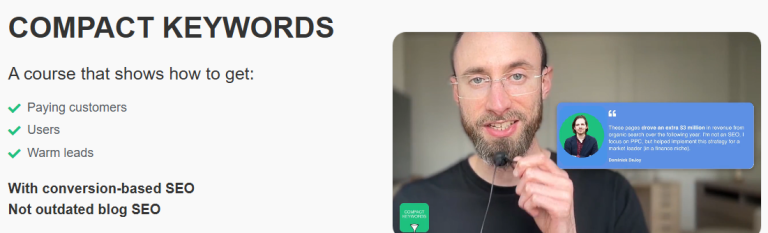

Edward Sturm – Compact Keywords Course: A Complete Review
Introduction: A Different Way to Approach SEO
Search engine optimization can become an expensive and time-consuming process when a business publishes large amounts of content without a clear connection to its products or services. Articles may attract visitors, but those visitors do not necessarily become customers, qualified leads, or paying subscribers.
This is the problem that Edward Sturm’s Compact Keywords course aims to address.
Rather than making traditional informational blogging the center of an SEO strategy, the course teaches a conversion-focused approach built around search terms that indicate a person’s need for a particular product, service, or solution. The objective is to connect relevant searches with landing pages that help potential customers take the next step.
For example, someone searching for general information about email marketing may still be researching their options. Someone searching for email marketing software for a specific business need may be closer to evaluating a solution. Both searches can be useful, but they serve different purposes.
Compact Keywords focuses on finding and targeting the second type of opportunity.
The training is associated with Edward Sturm, an SEO practitioner and entrepreneur who has worked with startups and established businesses. His method emphasizes keyword research, search intent, landing-page structure, technical foundations, and practical implementation.
But is this approach suitable for every business? Is it useful for beginners? And should you choose it over a more traditional SEO training program?
This review explores the course’s core concepts, curriculum, strengths, limitations, and potential value so you can make a more informed decision.
What Is Edward Sturm’s Compact Keywords Course?
Compact Keywords is an SEO training program that teaches businesses to identify commercially relevant search opportunities and build pages designed to address them.
The central idea is straightforward: instead of measuring SEO success only through traffic or rankings, businesses should consider whether their pages reach people who are likely to become customers, users, or qualified leads.
The course teaches a process for identifying these opportunities and turning them into targeted pages.
Its published curriculum covers areas such as:
- Keyword research and search intent.
- Conversion-focused SEO strategy.
- Website visibility and indexing.
- On-page optimization.
- Website structure and internal organization.
- Finding and evaluating compact keywords.
- Creating and publishing landing pages.
- Measuring results after publication.
- Link building and authority development.
- SEO applications involving video and user-generated content.
The course also includes practical examples across different industries, according to the published course materials.
Rather than presenting SEO as a collection of isolated tricks, the program organizes these elements into a broader process for finding opportunities, building relevant pages, and improving their ability to attract the right audience.
What Does “Compact Keywords” Mean?
The term refers to the course’s approach to identifying specific search phrases with commercial or action-oriented intent.
The emphasis is not simply on choosing short keywords. A useful target must be relevant to the business, match a real search need, and offer a reasonable opportunity to compete.
Consider these illustrative examples:
Broad informational search: “What is project management software?”
More commercially focused search: “Project management software for small agencies”
Service-focused search: “Emergency plumbing service in Austin”
The first search may come from someone learning about a category. The others may indicate a more specific need or an intention to evaluate available solutions.
These are examples of search intent, not verified keyword-volume or competition data.
The important distinction is that a keyword’s value depends on its context. A low-volume phrase can be commercially useful if it attracts relevant prospects, while a high-volume phrase may deliver limited business value if the visitors are unlikely to need what you sell.
Compact Keywords encourages businesses to investigate opportunities that conventional keyword research may overlook.
Who Is Edward Sturm?
Edward Sturm is an SEO practitioner, entrepreneur, and digital marketer who developed the Compact Keywords method.
His published background includes SEO work with businesses, experience in digital marketing, and teaching-related activities. His official course materials position Compact Keywords as a practical system that founders, marketers, and teams can implement themselves.
That positioning is relevant for people who want to understand SEO decisions rather than rely entirely on outside agencies.
However, an instructor’s professional background does not independently establish that every strategy will work for every student. A sensible evaluation should consider the quality of the training, the applicability of its examples, and whether the methods make sense for your particular market.
For prospective students, the more important question is whether the course provides a useful process they can apply to their own website and measure over time.
A Closer Look at the Compact Keywords Curriculum
The published curriculum is organized into sections that move from foundational concepts to keyword discovery, implementation, and ongoing optimization.
1. Understanding the Fundamentals of Commercial SEO
The opening material introduces the reasoning behind the Compact Keywords approach and explains how keyword selection can influence business outcomes.
Many businesses start with keywords that look attractive because they have high search volumes. However, search volume alone does not tell you whether a term will attract the right audience.
A more useful evaluation considers several questions:
- Does the search indicate a problem the business can solve?
- Is the searcher looking for a product, service, or provider?
- Does the website offer a relevant solution?
- Can the page answer the searcher’s needs clearly?
- Is there a realistic opportunity to compete for the query?
These questions help connect keyword research to commercial goals.
For beginners, this foundation can make SEO easier to understand because it links technical and content decisions to a specific business purpose.
2. Identifying High-Intent Search Opportunities
Keyword discovery is one of the central elements of the course.
The process involves looking beyond obvious industry terms and investigating the different ways potential customers describe their needs.
A software company, for example, might find opportunities related to a specific workflow, industry, team size, or business problem. A local service provider might identify searches tied to a location, service category, urgency, or customer requirement.
These variations can reveal useful landing-page opportunities when they reflect genuine demand.
However, keyword research still requires judgment. A phrase that sounds commercially valuable may have little actual demand, may be too competitive, or may not align with the business’s offering.
The value of a structured method is that it helps marketers investigate opportunities systematically instead of choosing keywords based on intuition alone.
3. Building Landing Pages That Match Search Intent
Finding a promising keyword is only part of the process. The website also needs a page that satisfies the searcher’s expectations.
Compact Keywords emphasizes pages designed to address specific commercial needs rather than relying exclusively on broad informational articles.
A well-planned landing page might explain:
- The particular problem being addressed.
- Who the product or service is suitable for.
- How the solution works.
- What makes the offering relevant to the search.
- Important features, limitations, or requirements.
- The appropriate next step for the visitor.
For a service business, the next step might be requesting a quote. For a software company, it might be starting a trial or booking a demonstration. For an ecommerce store, it could be viewing a relevant product or completing a purchase.
The page should be useful even when the visitor has not read any other content on the website.
This is one of the course’s most practical ideas: create a close connection between what someone searches for, what the page explains, and what the business offers.
4. On-Page SEO and Technical Visibility
A commercially relevant page cannot perform well in organic search if search engines cannot discover, crawl, index, or interpret it appropriately.
The course’s published curriculum includes visibility foundations, on-page SEO, and on-site SEO.
These topics address different parts of website optimization.
On-page SEO includes elements such as titles, headings, page content, descriptive language, and how well the page addresses the target query.
Technical SEO involves helping search engines access and understand the website. Depending on the site, this may involve crawlability, indexation, internal links, canonical URLs, and other technical considerations.
Site structure helps organize related pages so that users and search engines can understand how the website’s sections connect.
For a small business owner, learning these fundamentals can make it easier to identify common website problems before spending money on additional content or link building.
It is still important to distinguish between essential technical improvements and minor adjustments that may have little practical impact. Not every technical issue has the same level of importance, and SEO work should be prioritized according to the site’s actual needs.
5. Organizing the Website Around Relevant Search Needs
As a website expands, its structure can become difficult to manage. Pages may overlap, important services may be hard to find, and internal links may fail to communicate the relationships between related offerings.
Compact Keywords includes material on website structure and on-site SEO.
The broader principle is to create a logical organization that supports both users and search engines.
For example, a company offering several specialized services might use a main services page alongside focused pages for individual offerings. Each page should address a distinct need rather than simply repeating the same content with a different keyword.
This approach can also help businesses decide which pages deserve attention first.
A smaller, carefully planned website may be easier to maintain than a large collection of overlapping pages. However, the right structure depends on the number of offerings, the needs of the audience, and the competitive landscape.
6. Publishing Pages and Evaluating Performance
SEO work does not end when a page goes live.
The course includes material on publishing pages and evaluating results afterward. This is important because keyword research involves assumptions that need to be tested against real-world data.
After publishing, a business can monitor indicators such as:
- Whether the page has been indexed.
- Search impressions and clicks.
- Ranking changes for relevant queries.
- Organic traffic quality.
- Leads, inquiries, or sales attributed to the page.
- Conversion rates and user behavior.
- Changes in performance over time.
These measurements should be interpreted together.
For example, a page might receive more impressions but few clicks. That could suggest a mismatch between the query and the page title, weak visibility, or a search-results environment that does not encourage clicks.
Another page might receive relatively few visitors but generate qualified inquiries. In that case, its commercial value may be greater than its traffic volume suggests.
The goal is to evaluate whether the page is helping the business, not simply whether its traffic graph is increasing.
7. Link Building and Authority
The published curriculum also includes link building.
Links from relevant, reputable websites can help search engines discover content and assess its relationship to the broader web. They can also bring referral traffic and introduce a business to new audiences.
However, links should not be treated as an automatic ranking shortcut.
A responsible link-building strategy focuses on relevance, credibility, and genuine value. Businesses should avoid manipulative link schemes or purchasing links intended to artificially influence rankings.
The course’s overall emphasis on targeted pages does not mean backlinks are never useful. Competitive search results, the website’s existing authority, and the nature of the target query all influence how much link development may be needed.
8. Applying the Method Beyond Traditional Blog Content
The course materials also discuss SEO opportunities involving video and user-generated content.
This broadens the discussion beyond conventional website articles.
Depending on the platform and search behavior, useful optimization opportunities may exist in video titles, descriptions, service listings, product pages, and other content formats.
The underlying principle remains similar: understand what people are looking for, create something relevant to that need, and make it easy for the intended audience to discover and act on it.
Businesses should not assume that the same optimization tactics work identically across every platform. Search engines, video platforms, and other discovery systems have different ranking and presentation mechanisms.
The benefit of considering multiple formats is that it can help a business build a more flexible discovery strategy instead of depending entirely on one content type.
What Makes Compact Keywords Different From Traditional SEO?
Compact Keywords is positioned as an alternative emphasis within SEO, rather than a replacement for every established SEO practice.
The following comparison illustrates the distinction.
| SEO consideration | Broad informational approach | Compact Keywords approach |
|---|---|---|
| Primary emphasis | Answering questions and building topical awareness | Targeting specific, commercially relevant searches |
| Typical content | Educational articles and guides | Focused landing pages and solution-oriented content |
| Main objective | Inform, attract, and build awareness | Connect relevant searches with an appropriate next step |
| Keyword selection | Often includes broad informational terms | Prioritizes purchase or action intent |
| Conversion path | May require several steps before a sale | Attempts to connect the search directly with the offering |
| Measurement | Often includes traffic, engagement, and visibility | Also emphasizes leads, customers, and other commercial outcomes |
This is a simplified comparison, not a claim that all blog SEO is ineffective or that all landing pages convert well.
Informational content can be valuable for complex products, research-driven purchases, brand authority, and customer education. Some businesses need a combination of educational content and commercial pages.
The practical lesson is to choose content based on the business goal and the searcher’s needs instead of publishing articles simply to increase the number of pages on a website.
Potential Benefits of the Compact Keywords Course
A More Commercially Focused SEO Strategy
The course encourages students to connect keyword research with the business outcomes they want to achieve.
For businesses that have focused heavily on traffic without seeing meaningful leads or sales, this can be a useful change in perspective.
Practical Implementation
The published curriculum includes lessons, templates, and examples. These resources may help learners move from general SEO concepts to a more structured implementation process.
The value of any template depends on how well it fits the business. Students should expect to adapt the materials rather than copy every example without considering their market.
Relevance for Different Business Models
The official course materials present examples across multiple industries, including services, ecommerce, software, and local businesses.
That variety can help students understand how commercial search intent differs from one market to another.
Still, an approach that works well for one type of business may need substantial adjustment for another.
A Better Way to Prioritize SEO Work
Smaller businesses often have limited time, budgets, and staff. A structured keyword-selection process may help them decide which pages to build or improve first.
This does not guarantee quick rankings. It can, however, make planning more deliberate by connecting each proposed page to a defined search need and business objective.
Useful Foundations for Independent Marketers
Learning keyword research, landing-page optimization, and technical SEO can help business owners make more informed decisions when managing their own websites or evaluating outside SEO services.
The skills may also be useful for freelancers and marketers who work across multiple client websites.
Limitations and Things to Consider
A balanced review should consider where the method may be less suitable or where expectations need to be realistic.
Results Are Not Guaranteed
A well-targeted keyword does not guarantee a first-page ranking, a high conversion rate, or a sale.
Search competition, website authority, content quality, technical performance, customer demand, and many other factors influence results.
Course testimonials may provide examples of individual experiences, but they should not be treated as a reliable forecast of what every student will achieve.
Keyword Research Still Requires Judgment
Not every specific phrase is a valuable opportunity.
A keyword may have very little demand, attract the wrong audience, or be dominated by established competitors. Search-volume estimates from SEO tools can also be imperfect.
Students need to evaluate potential keywords rather than assume that low competition automatically makes a term worthwhile.
Some Businesses Need Informational Content
The course’s contrast between commercial landing pages and traditional blog SEO is useful as a strategic perspective, but it should not be interpreted as a universal rule against educational content.
Businesses selling complex or expensive products may need detailed guides, comparison resources, demonstrations, and educational material to help customers make informed decisions.
Informational pages can also support brand awareness, internal linking, and customer trust.
The most appropriate strategy depends on the business model and how customers research and purchase.
Implementation Takes Time
Even a streamlined approach requires research, planning, writing, publishing, and measurement.
Technical issues may need additional attention, and competitive markets can require sustained work before results become meaningful.
The course can provide a framework, but students should not expect to achieve the same outcomes or timelines shown in promotional examples.
Tools May Add to the Cost
The official course materials identify SEO software such as Moz and mention alternatives including Ahrefs and Semrush.
These tools can help with keyword research and related analysis, but subscriptions may represent an additional expense.
Before purchasing the course, confirm which tools you already have, which features you need, and whether the current course requires any specific software or paid plan.
Who Should Consider Compact Keywords?
Small business owners: Those who want a more systematic way to attract people searching for the services or products they provide.
Ecommerce operators: Store owners who want to investigate commercially relevant product and category searches instead of relying only on broad informational traffic.
SaaS founders: Software businesses seeking search opportunities related to specific workflows, use cases, industries, or customer requirements.
Freelance SEO professionals: Marketers who want to add a more commercially focused keyword and landing-page framework to their existing skills.
Marketing teams: Teams that need a repeatable process for identifying search opportunities and prioritizing page development.
Beginners in SEO: People who want structured training in keyword research and implementation, provided they are prepared to learn the fundamentals and test what they learn.
Who Might Not Need This Course?
Compact Keywords may be less suitable for someone who expects SEO to produce immediate results without ongoing work.
It may also be a poor fit for a business that has not yet established a clear product, service, or target audience. Commercial keyword targeting is difficult when the offering itself is poorly defined.
Businesses that already have an effective SEO strategy may find that some of the material overlaps with their current practices. In that situation, it is worth reviewing the detailed curriculum before paying for additional training.
Similarly, if your main objective is to create an extensive educational publication, an SEO course focused on editorial strategy and topical coverage may address your needs more directly.
The best choice depends on what you are trying to achieve and which skills you still need to develop.
Is Edward Sturm’s Compact Keywords Course Worth It?
Whether Compact Keywords is worth the investment depends on your current SEO knowledge, business model, and ability to implement the method.
Its strongest selling point is its clear focus on commercial intent. Rather than treating traffic as the only measure of success, the course encourages students to connect search opportunities with pages designed to generate meaningful business actions.
The curriculum also covers more than keyword discovery. It includes landing-page creation, technical foundations, website structure, publishing, performance evaluation, and link building.
That broader coverage may appeal to people who want a process they can apply to an actual website.
Before purchasing, compare the current price with the time and money you expect to invest in implementation. Review the full curriculum, the tools required, the access terms, and the refund policy.
It is also worth considering whether you have the resources to create and maintain the pages you identify through keyword research. A good strategy is only useful when the business can execute it.
Final Verdict
Edward Sturm’s Compact Keywords course offers a commercially focused way to approach search engine optimization.
Its emphasis on purchase-intent searches, targeted landing pages, and practical implementation may be especially useful for businesses that want organic search to contribute more directly to lead generation and sales.
The training also covers important supporting topics, including keyword research, technical SEO, website structure, page publishing, performance measurement, and link building.
However, the method should not be mistaken for a guaranteed ranking shortcut or a universal replacement for informational content. Search intent, competition, site quality, and business circumstances still matter.



Reviews
There are no reviews yet.